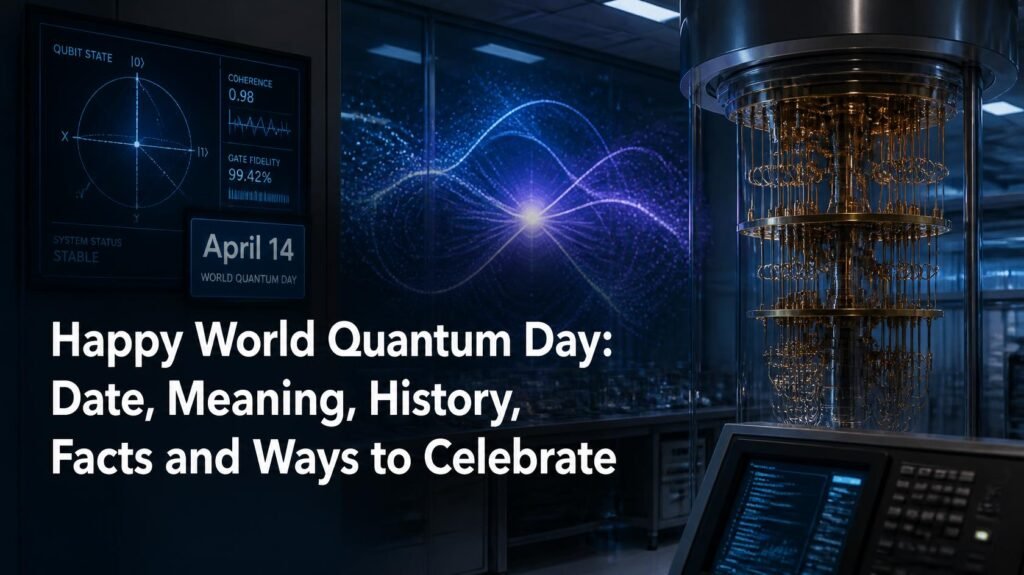
Every year on April 14, World Quantum Day brings attention to one of the most fascinating areas of modern science: quantum science and technology. If you are searching for “happy World Quantum Day,” you may simply want to know when the day is celebrated, why April 14 was selected, what World Quantum Day means, or how people around the world take part. At its heart, the occasion is about making quantum science easier for everyone to understand and showing how ideas developed at the smallest scales can influence technology, research, communication, computing, medicine, and everyday life.
World Quantum Day is an international, community-driven initiative rather than a United Nations-designated observance. It was launched by quantum scientists from around the world in 2021 as a countdown toward the first global celebration in 2022. The initiative encourages scientists, educators, students, engineers, communicators, artists, businesses, and the wider public to explore quantum science and discuss its potential impact on society.
The date itself has a scientific connection. April 14 represents 4.14, a reference to the rounded first digits of Planck’s constant, one of the fundamental constants associated with quantum physics. That connection gives the observance a memorable identity while linking the date directly to the science it celebrates.
What Is World Quantum Day?
World Quantum Day is an annual global celebration designed to increase public awareness and understanding of quantum science and technology. Unlike a traditional public holiday, it is primarily an educational and scientific observance. Its purpose is not simply to celebrate discoveries but to help people understand why quantum research matters and how it can influence the future.
The official World Quantum Day initiative describes itself as decentralized and bottom-up. Rather than relying on one central organization to conduct a single worldwide ceremony, it encourages organizations and individuals to create their own activities. These can include public lectures, exhibitions, laboratory tours, panel discussions, interviews, classroom activities, artistic projects, demonstrations, and other forms of science outreach.
This approach makes World Quantum Day accessible to very different audiences. A university physics department might organize a technical seminar, while a school could introduce students to simple quantum concepts. A museum might create an exhibition, and a technology organization might discuss quantum computing or cybersecurity. The common purpose is to make quantum science understandable and encourage curiosity.
When Is World Quantum Day?
World Quantum Day is celebrated every year on April 14.
In 2026, World Quantum Day took place on April 14, 2026. The official World Quantum Day initiative continues to encourage activities not only on April 14 itself but also during the surrounding days and weeks.
The choice of April 14 is one of the most interesting facts about the observance. The date references 4.14, the rounded first digits of Planck’s constant when expressed in electronvolt-seconds. Planck’s constant is fundamental to quantum mechanics because it helps describe the relationship between energy and frequency at the quantum level.
So, when people say “Happy World Quantum Day,” they are not celebrating an arbitrary date. April 14 is intentionally connected to one of the central ideas of quantum physics.
Why Is World Quantum Day Celebrated?
The world depends on technologies that are closely connected to scientific discoveries that once seemed extremely theoretical. Quantum science is an excellent example. Research into the behavior of atoms, electrons, photons, and other microscopic systems has contributed to technologies ranging from semiconductors and lasers to medical imaging and modern communication systems.
The U.S. National Quantum Initiative explains that quantum mechanics describes atoms and particles at the building-block level of nature and has helped scientists and engineers create technologies that affect everyday life, including semiconductor-based devices.
World Quantum Day therefore has a broader purpose than celebrating quantum computers. It recognizes the foundations of quantum science, its history, its practical applications, and the new technologies being developed from quantum principles.
The day also helps close the gap between scientific communities and the general public. Quantum mechanics can sound intimidating because it involves concepts that do not match everyday experience. Ideas such as superposition, entanglement, uncertainty, and quantum states can initially seem strange. Public education makes these subjects easier to approach and gives students and non-specialists an opportunity to participate in conversations about future technology.
The History of World Quantum Day
World Quantum Day was launched on April 14, 2021, by an international group of quantum scientists as a countdown toward the first global celebration planned for April 14, 2022. The initiative began as a decentralized effort and invited scientists, engineers, educators, communicators, entrepreneurs, technologists, historians, philosophers, artists, and other communities to participate.
The first global celebration took place in 2022. CERN’s account of the initiative notes that the first celebration included more than 200 events across 40-plus countries, covering areas such as quantum mechanics, quantum information, quantum computing, optics, engineering, history, and the societal implications of quantum science.
Since then, World Quantum Day has developed into a global platform for public engagement. Its activities have expanded beyond traditional academic lectures to include schools, museums, arts initiatives, exhibitions, educational programs, and community events.
This growth reflects a larger change in how quantum science is viewed. It is no longer only a subject for theoretical physicists. Quantum technologies are increasingly connected with computing, sensing, communications, cybersecurity, healthcare, materials science, finance, logistics, and other fields.
Why April 14 Is Connected to Planck’s Constant
One of the most searched questions about World Quantum Day is why it takes place on April 14. The answer is found in Planck’s constant, represented by the symbol h.
Planck’s constant has a defined value of approximately 4.135667696 × 10⁻¹⁵ electronvolt-seconds. Its rounded first digits are 4.14, which inspired the choice of April 14 for World Quantum Day.
Planck’s constant is deeply connected to quantum physics because it appears in equations describing the relationship between energy and frequency. The introduction of this constant was part of the historical development that led scientists toward the modern understanding of quantum mechanics.
For World Quantum Day, the number 4.14 serves as a simple bridge between the calendar and the science. Someone who sees April 14 on a calendar might not immediately think about quantum mechanics, but the date provides an opportunity to ask why it was selected and learn about the science behind it.
What Does Quantum Science Actually Mean?
Quantum science explores nature at very small scales, including the behavior of atoms, electrons, photons, and other microscopic systems. At these scales, physical behavior can differ dramatically from what people experience in ordinary everyday life.
One important idea is superposition. In simplified terms, a quantum system can exist in a combination of possible states until a measurement is made. Quantum computing uses this and other quantum properties in ways that differ fundamentally from classical computing.
Another important concept is quantum entanglement, in which quantum systems can have correlations that cannot be explained using ordinary classical descriptions. Entanglement has become important in research into quantum communication, quantum information, and quantum computing.
These concepts should not be treated as magic or science fiction. They are part of a well-developed scientific framework supported by extensive experimentation. At the same time, quantum technology remains an active research field, and many practical applications are still being developed.
Why Quantum Technology Matters for the Future
Quantum technology is attracting significant attention because researchers believe it could provide new approaches to problems that are difficult for conventional technologies.
Quantum computing is one of the best-known areas. Classical computers use bits represented as 0 or 1, while quantum computers use quantum bits, or qubits, whose states can exploit quantum-mechanical properties. This does not mean quantum computers will simply replace ordinary computers. Instead, they are being developed for particular categories of problems where quantum approaches may eventually offer advantages.
Quantum communication is another important area. Researchers are investigating ways to use quantum properties for new communication and security techniques, including technologies related to quantum key distribution.
Quantum sensing can potentially provide highly sensitive measurements of physical quantities such as magnetic fields, time, acceleration, and gravity. Such capabilities may have applications in navigation, medicine, scientific research, and other fields.
The potential impact explains why governments, universities, technology companies, and research organizations around the world are investing in quantum science.
World Quantum Day and the International Year of Quantum Science and Technology
World Quantum Day became especially significant during 2025, when the United Nations declared 2025 the International Year of Quantum Science and Technology.
The UN General Assembly adopted Resolution A/RES/78/287 on June 7, 2024, proclaiming 2025 as the International Year of Quantum Science and Technology, with UNESCO serving as the lead agency. The international year aimed to increase awareness of quantum science and applications, strengthen scientific cooperation, encourage sustainable applications, and help reduce disparities in quantum research and education.
UNESCO described the initiative as an opportunity to encourage global collaboration, build capacity, engage young people, promote gender equality in STEM, and address the growing gap between regions in quantum research and innovation.
This distinction is important. World Quantum Day itself is not a UN-designated international day. The UN’s official designation concerned the International Year of Quantum Science and Technology in 2025. World Quantum Day is an independent, community-driven observance that existed before the UN year and continues afterward.
How People Celebrate World Quantum Day
Because World Quantum Day is primarily an educational observance, celebrations can take many forms.
Schools can organize introductory lessons about quantum physics, invite university researchers to speak with students, or conduct age-appropriate demonstrations. Universities and research institutions can hold public lectures, laboratory tours, conferences, and workshops.
Museums can create interactive exhibits explaining quantum ideas through visual demonstrations. The World Quantum Day initiative also promotes Quantum@School, Quantum@Museum, Quantum@Arts, and other outreach projects designed to bring quantum science into different environments.
Individuals can participate without having a physics background. Watching a reliable introductory lecture, reading about quantum mechanics, visiting a science museum, exploring a quantum computing tutorial, or discussing a recent quantum discovery can all turn April 14 into a meaningful learning experience.
For students, World Quantum Day can also be an opportunity to explore careers in physics, computer science, engineering, mathematics, materials science, and emerging technology.
World Quantum Day Activities for Students
Students do not need advanced mathematics to participate in World Quantum Day. The most valuable activity may simply be developing curiosity about how the physical world works.
A classroom could begin with a basic question: How is a quantum computer different from a normal computer? Students could then investigate bits and qubits, learn what superposition means, and discuss why quantum computers are still difficult to build.
Another activity could focus on the history of quantum science. Students can explore major developments from Max Planck and Albert Einstein through the development of quantum mechanics and into modern quantum information science.
Schools can also organize poster competitions, science presentations, guest lectures, short research projects, or discussions about the benefits and challenges of emerging quantum technologies.
The official World Quantum Day initiative specifically encourages schools to connect students with quantum science and technology through activities around April 14.
World Quantum Day in the Modern Technology Era
Quantum science is becoming increasingly relevant as societies discuss the next generation of computing and communications. Companies and research institutions are working on different approaches to quantum hardware, software, algorithms, error correction, sensing, and networking.
At the same time, it is important to avoid exaggerated claims. Quantum technology is promising, but many systems remain experimental or limited in scale. Building reliable, large-scale, error-corrected quantum computers is still a major engineering challenge. Google Quantum AI, for example, describes the development of stable, error-corrected systems as a long-term challenge while exploring possible applications such as materials and drug discovery.
That balance between excitement and realism is one reason World Quantum Day matters. It creates space to celebrate genuine scientific progress while encouraging people to understand what has already been achieved, what remains uncertain, and what researchers are still trying to solve.
How to Say “Happy World Quantum Day”
If you are looking for a simple World Quantum Day greeting, you can keep it connected to curiosity, science, and discovery.
Happy World Quantum Day! May curiosity inspire new discoveries, new ideas, and a deeper understanding of the fascinating quantum world.
For students, a shorter message can work well:
Happy World Quantum Day! Keep asking questions, exploring science, and imagining what the future of quantum technology could bring.
For social media, you could write:
Happy World Quantum Day! From quantum mechanics to quantum computing, today is a reminder that some of the biggest technological possibilities begin with understanding the smallest building blocks of nature.
These messages work because the purpose of the occasion is not simply celebration. It is also about learning, sharing knowledge, and encouraging curiosity.
Interesting World Quantum Day Facts
World Quantum Day has several facts that make it different from many other awareness observances:
- World Quantum Day is celebrated annually on April 14.
- The date is connected with 4.14, referencing the rounded first digits of Planck’s constant.
- The initiative was launched on April 14, 2021.
- The first global celebration took place on April 14, 2022.
- It is a decentralized, community-driven initiative, rather than a UN-designated observance.
- The observance covers much more than quantum computing, including quantum physics, information science, optics, sensing, communication, engineering, education, history, and the social implications of quantum technology.
- The United Nations separately designated 2025 as the International Year of Quantum Science and Technology.
- In 2026, World Quantum Day continued after the UN’s quantum year, with the official initiative encouraging events around April 14.
- Google marked World Quantum Day 2026 with a Doodle featuring the Bloch Sphere, a visualization associated with qubit states.
Why World Quantum Day Matters
The deeper value of World Quantum Day is that it makes advanced science part of public conversation. Quantum research can influence fields that may appear unrelated to physics, including medicine, communications, computing, energy, cybersecurity, navigation, materials, and scientific measurement.
It also highlights the importance of education. The future of quantum technology will depend not only on specialized researchers but also on teachers, engineers, software developers, policymakers, entrepreneurs, communicators, and students who understand enough about the field to participate responsibly.
UNESCO’s work around the International Year of Quantum Science and Technology emphasized the need to expand quantum education and capacity, particularly in developing regions, while encouraging young people and underrepresented groups to explore opportunities in the field.
For that reason, World Quantum Day is ultimately about more than a single date. It is an invitation to learn about a scientific revolution that began more than a century ago and continues to shape new possibilities today.
Frequently Asked Questions About World Quantum Day
When is World Quantum Day celebrated?
World Quantum Day is celebrated every year on April 14. The date references 4.14, the rounded first digits of Planck’s constant.
What is the purpose of World Quantum Day?
The purpose is to promote public awareness and understanding of quantum science and technology and encourage people around the world to engage with the subject through education, research, outreach, events, and creative activities.
Is World Quantum Day a UN holiday?
No. World Quantum Day is a decentralized, community-driven initiative created by quantum scientists. The United Nations did separately proclaim 2025 the International Year of Quantum Science and Technology.
When did World Quantum Day start?
The initiative was launched on April 14, 2021, with the first global celebration taking place on April 14, 2022.
Why is April 14 called World Quantum Day?
April 14 represents 4.14, a reference to the rounded first digits of Planck’s constant, a fundamental constant in quantum physics.
How can students celebrate World Quantum Day?
Students can attend lectures, explore beginner-friendly quantum science resources, create science projects, learn about quantum computing, participate in school events, visit science museums, or organize educational presentations.
What is the difference between quantum physics and quantum computing?
Quantum physics is the broader scientific field describing the behavior of matter and energy at microscopic scales. Quantum computing is an emerging technology that uses quantum-mechanical properties to process information in ways that differ from classical computing.
Is World Quantum Day celebrated in 2026?
Yes. World Quantum Day 2026 was observed on April 14, 2026, with events and activities organized internationally. The official initiative encouraged celebrations around April 14 and continued its efforts to expand public understanding of quantum science and technology.
Conclusion
Happy World Quantum Day is more than a greeting for April 14. It represents a global invitation to understand one of the most influential areas of modern science. From the fundamental behavior of particles to emerging technologies such as quantum computing, sensing, and communication, quantum science continues to change how researchers understand nature and how engineers imagine future technologies.
The observance began as a grassroots initiative launched by quantum scientists in 2021 and developed into an international platform for education and public engagement. Its April 14 date carries a scientific meaning through the 4.14 reference to Planck’s constant, while its decentralized structure allows schools, universities, museums, researchers, businesses, artists, and individuals to participate in their own ways.
The UN’s International Year of Quantum Science and Technology in 2025 gave the subject even greater global visibility, but the continuing role of World Quantum Day is equally valuable: helping ordinary people understand why quantum science matters.
So, whether you are a student discovering quantum mechanics for the first time, a teacher introducing the subject in a classroom, a researcher sharing your work, or simply someone curious about the future, April 14 is a good reminder to keep asking questions. Happy World Quantum Day — and keep exploring the quantum world.
If you mean FAQs, here are SEO-friendly FAQs for your article:
FAQs About Happy World Quantum Day
1. When is World Quantum Day celebrated?
World Quantum Day is celebrated every year on April 14.
2. Why is April 14 World Quantum Day?
April 14 represents 4.14, referencing the rounded first digits of Planck’s constant, an important constant in quantum physics.
3. What is World Quantum Day?
World Quantum Day is a global, community-driven observance that promotes awareness, education, and understanding of quantum science and technology.
4. Is World Quantum Day an official UN day?
No. World Quantum Day is not a UN-designated day. However, the United Nations declared 2025 the International Year of Quantum Science and Technology.
5. When did World Quantum Day start?
World Quantum Day was launched on April 14, 2021, with the first global celebration held in 2022.
6. How can I celebrate World Quantum Day?
You can celebrate by learning about quantum physics, attending science events, watching educational lectures, exploring quantum computing, or sharing Happy World Quantum Day messages.
7. Why is quantum science important?
Quantum science provides the foundation for technologies such as quantum computing, quantum communication, quantum sensing, lasers, and many modern electronic technologies.
