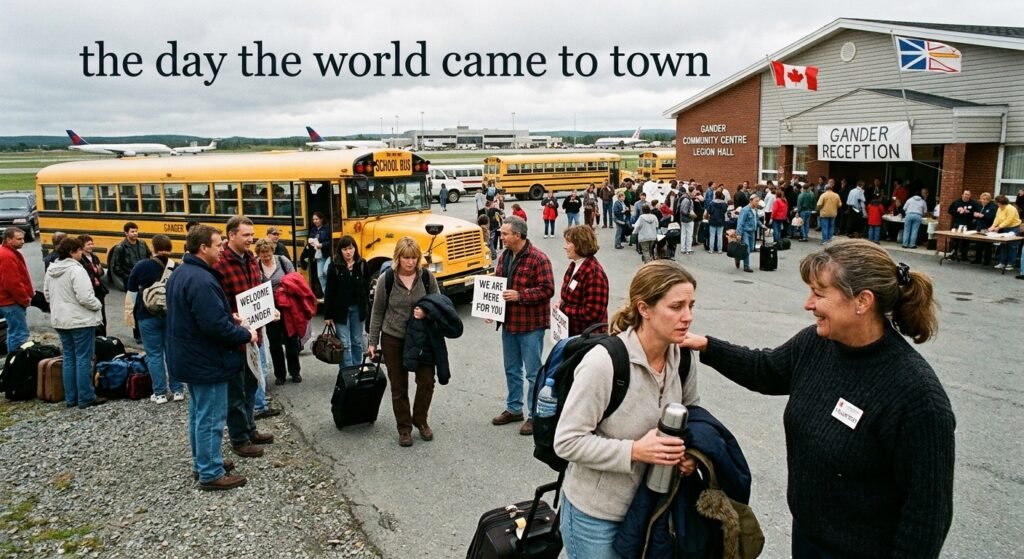
On September 11, 2001, the world changed in a matter of hours. As the United States closed its airspace following the terrorist attacks, hundreds of aircraft were forced to change course. Some turned back. Others searched for airports where they could safely land.
For dozens of international flights, that destination was Gander, Newfoundland, Canada.
What happened next became one of the most remarkable stories of compassion to emerge from one of the darkest days in modern history.
The Day the World Came to Town is also the title of journalist Jim DeFede’s nonfiction book about those events. The book documents how the small Newfoundland community of Gander and surrounding areas suddenly found itself caring for thousands of unexpected visitors.
It is a story about aviation, history, fear, hospitality, and the extraordinary things ordinary people can do when circumstances demand it.
What Is The Day the World Came to Town About?
The Day the World Came to Town: 9/11 in Gander, Newfoundland is a nonfiction account by journalist Jim DeFede. First published in 2002, the book focuses on what happened in Gander after September 11, 2001.
At the center of the story is a simple but extraordinary situation: aircraft that had been traveling toward the United States suddenly had nowhere to go.
With American airspace closed, numerous international flights were diverted to other airports. Gander International Airport was one of the places able to receive them.
The arrival of the aircraft transformed a relatively small community into a temporary home for thousands of people from around the world.
DeFede’s book tells the story through the experiences of passengers, local residents, officials, transportation workers, and others who became part of the unexpected crisis.
Rather than focusing only on the events in the sky, the book examines what happened after the planes landed—and how a community responded when thousands of strangers suddenly needed food, shelter, transportation, communication, and reassurance.
Why Did So Many Planes Land in Gander?
To understand the story, it helps to understand Gander’s unusual place in aviation history.
Gander is located on the island of Newfoundland in eastern Canada. Its airport had long been strategically important because of Newfoundland’s location between North America and Europe.
Before the era of modern long-range aircraft, airports such as Gander were particularly important stops for transatlantic aviation. Although aviation technology changed over the decades, Gander retained an airport capable of handling large aircraft.
That capability became critically important on September 11, 2001.
After the attacks in the United States, North American airspace was shut down. As a result, aircraft already in flight had to be redirected.
According to published accounts of DeFede’s book, 38 jetliners were diverted to Gander, bringing thousands of passengers and crew members into a town whose population was only around 10,000.
The numbers alone are striking.
Imagine a community suddenly receiving a population increase of several thousand people—not for a planned festival or sporting event, but because of an international emergency.
There were no weeks of preparation.
There was no opportunity to order supplies months in advance.
People simply had to respond.
The Arrival of the “Plane People”
For the passengers, landing in Gander was only the beginning.
Many had been traveling for hours before learning that their destination had changed. They were far from home, unsure about what had happened, and trying to understand rapidly changing news.
The passengers also had to remain on the aircraft for an extended period while authorities dealt with security procedures and determined what would happen next. Publisher descriptions of the book recount how passengers eventually left the planes and encountered a community prepared to help them.
The local response was remarkable.
Gander residents and people from surrounding communities began organizing food, transportation, accommodation, clothing, showers, communication facilities, and other necessities.
The stranded passengers became known locally as the “plane people.”
That phrase captures something important about the story. The travelers were initially strangers—people who happened to be aboard aircraft that needed somewhere to land.
But after several days in Gander, many were no longer treated as anonymous travelers.
They became guests.
How Gander Residents Responded
The most memorable part of the story is not simply the number of aircraft that arrived. It is how quickly ordinary people organized themselves to help.
Residents opened their homes.
Community facilities became temporary shelters.
Food was prepared and distributed.
Transportation was arranged.
Supplies were gathered.
People helped strangers contact their families and follow the news.
According to descriptions of DeFede’s book, local bus drivers even left a labor strike to help transport stranded passengers. Schools and other community facilities were also used to provide essential services.
None of this was a simple task.
Thousands of people had different languages, dietary requirements, medical needs, personal circumstances, and emotional reactions to the crisis.
Some passengers were traveling alone. Others were traveling with children. Some had urgent family situations waiting for them elsewhere.
The people of Gander could not solve every problem.
What they could do was make the situation a little less frightening.
And that mattered.
A Community Becomes a Temporary Home
One of the central themes of The Day the World Came to Town is hospitality.
Hospitality can sound like a small thing. It might mean offering someone a meal, giving directions, or making a guest comfortable.
In Gander, hospitality took on a completely different scale.
Residents had to make room for people they had never met.
Homes became places of rest. Public buildings became shelters. Local businesses and community organizations helped supply necessities.
The travelers needed practical assistance, but they also needed something less tangible: reassurance.
The world outside was frightening and uncertain.
Inside Gander, they encountered people who were willing to help.
That contrast gives the story much of its emotional power.
The residents were not professional disaster responders in every case. They were teachers, drivers, families, workers, students, volunteers, and neighbors.
They were simply people who saw other people in need.
The Human Stories Behind the Event
A major strength of DeFede’s account is its focus on individual experiences.
Large historical events are often remembered through numbers: the number of aircraft, passengers, casualties, emergency workers, or days.
Numbers are important, but they can also make history feel distant.
Personal stories bring it closer.
A passenger worried about family.
A local resident trying to find enough supplies.
A volunteer wondering where another group of travelers could sleep.
A worker putting normal responsibilities aside to help.
These individual experiences reveal what a major crisis actually feels like on the ground.
The book is structured as an oral history, drawing on the experiences of people connected to the events. Library records classify the work under subjects including air travel in Gander, the September 11 attacks, commercial aviation, and Gander’s history.
That approach helps explain why the book remains compelling.
It is not simply a timeline of what happened.
It is a collection of human experiences connected by an extraordinary few days.
How Long Were the Passengers in Gander?
The stranded travelers did not simply arrive, spend a few hours, and continue their journeys.
The closure of American airspace meant that the passengers remained in Gander for several days while authorities worked through the enormous disruption.
Accounts of the book describe the events as unfolding over roughly four to six days, with the narrative organized into sections covering the initial arrival, subsequent days, and the eventual departure of the travelers.
Those days were long enough for something unexpected to happen.
Strangers began forming relationships.
Passengers and residents talked.
Meals were shared.
Stories were exchanged.
People who had never expected to visit Newfoundland suddenly experienced the community at its most generous.
For the residents, the visitors were no longer simply passengers from a distant country.
For many passengers, Gander became more than an airport stop.
It became a place they remembered.
What Makes the Story So Powerful?
There are many stories about September 11, 2001. Most naturally focus on the attacks themselves, the people who died, the emergency response, and the enormous consequences that followed.
The Gander story occupies a different place in that history.
It does not ignore the tragedy.
Instead, it shows what happened in one corner of the world while that tragedy was unfolding.
That makes it an unusual historical story.
At a time when fear and suspicion were spreading, Gander offered a different image: strangers helping strangers.
The significance is not that everything was perfect.
No community could instantly solve a crisis of that magnitude.
The significance is that people tried.
They cooked.
They drove.
They donated.
They listened.
They opened their doors.
They helped.
Sometimes, that is what history looks like—not a single dramatic act, but thousands of small decisions made by ordinary people.
From Book to Stage: The Legacy of the Story
The story of Gander eventually reached an even wider audience through Come From Away, the acclaimed musical inspired by the events.
The musical helped introduce the Gander story to audiences who might never have encountered Jim DeFede’s book.
But the book remains important because it provides a nonfiction account of the people and circumstances behind the story.
DeFede’s work has also been published in updated editions, including an edition that presents the story as the real-life inspiration behind Come From Away.
The popularity of the musical demonstrates something remarkable about the original events.
More than two decades later, people are still interested in what happened in a small Canadian community when the normal rules of travel and everyday life suddenly disappeared.
That lasting interest is not only about aviation.
It is about human behavior.
People want to know what others do when circumstances become difficult.
And Gander provides an encouraging answer.
Lessons From the Day the World Came to Town
The story offers several lessons that remain relevant.
1. Small communities can make a huge difference
Gander was not a global capital.
It did not have unlimited resources.
Yet its people responded to an international emergency in a way that affected thousands of lives.
The story is a reminder that influence is not always connected to size.
2. Hospitality can be practical
Kindness is not always about saying the right words.
Sometimes kindness means providing a bed, a meal, a bus ride, a shower, a telephone, or a place to sit.
During a crisis, practical help can be deeply meaningful.
3. History is made by ordinary people
The people remembered in this story were not all famous.
Many were simply residents who decided to help.
That is one of the most valuable reminders in historical storytelling: ordinary people can become part of extraordinary moments.
4. Unexpected connections can last
The relationships formed during those days did not necessarily disappear when the passengers left.
The story records lasting connections, including expressions of gratitude and efforts to support the community after the travelers eventually returned home.
That lasting connection is part of what makes the Gander story different from a temporary act of emergency assistance.
Why Read The Day the World Came to Town Today?
For readers interested in history, the book provides a perspective on September 11 that is both specific and deeply human.
It is useful for readers who want to understand:
- What happened to international flights after U.S. airspace closed.
- Why Gander became a major diversion point.
- How a small community handled thousands of unexpected visitors.
- What life was like for stranded passengers.
- How ordinary residents responded to an international crisis.
- Why the Gander story became the inspiration for Come From Away.
It is also a reminder that historical events rarely have only one story.
September 11 was a tragedy of enormous scale. But within that history were also stories of courage, generosity, cooperation, confusion, grief, and compassion.
Gander represents one of those stories.
Frequently Asked Questions
What is The Day the World Came to Town about?
The Day the World Came to Town is a nonfiction book by journalist Jim DeFede about the events in Gander, Newfoundland, following the September 11, 2001 attacks. It focuses on the diverted aircraft and the community’s response to thousands of stranded travelers.
How many planes were diverted to Gander on 9/11?
Published descriptions of DeFede’s book state that 38 jetliners were diverted to Gander after U.S. airspace was closed. The aircraft carried thousands of passengers and crew members.
Where is Gander?
Gander is a town in Newfoundland and Labrador, Canada. Its airport has a long history of strategic importance to transatlantic aviation because of the region’s geographic location.
Is The Day the World Came to Town a true story?
Yes. It is a nonfiction account by journalist Jim DeFede based on the experiences of people involved in or affected by the events in Gander after September 11, 2001. Library and publisher records identify it as nonfiction and document its historical focus.
Is Come From Away based on the same story?
Yes. Come From Away was inspired by the events surrounding the stranded passengers and the people of Gander and surrounding communities after September 11. DeFede’s book is one of the major nonfiction accounts of those events.
Conclusion
The day the world came to town was, in many ways, a day nobody in Gander expected.
Thousands of travelers arrived because they had nowhere else to go. They came carrying luggage, uncertainty, fear, and questions about what was happening in the world.
What they found was a community willing to help.
The story of Gander does not change what happened on September 11, 2001, nor does it diminish the tragedy of that day. Instead, it preserves another part of the historical record: the way people responded when strangers suddenly needed them.
Jim DeFede’s The Day the World Came to Town remains an important account because it places human experiences at the center of a global event.
Its lasting message is remarkably simple.
When people are faced with fear and uncertainty, compassion still matters.
Sometimes a town can become a refuge.
Sometimes strangers can become friends.
And sometimes, in the middle of a terrible moment in history, the actions of ordinary people can give the world a reason to remember something good.
