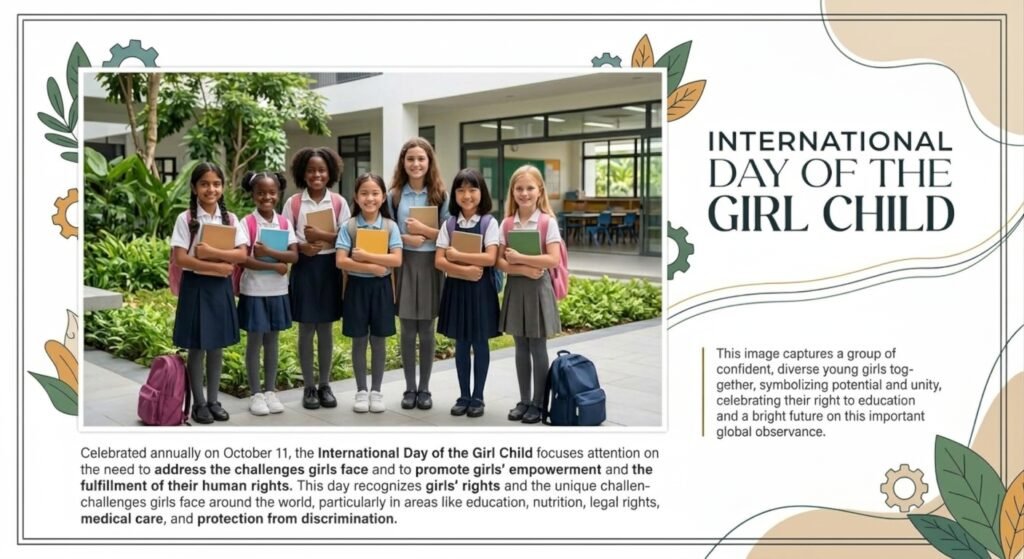
Every girl deserves the opportunity to learn, grow, feel safe, and build a future filled with possibilities. Yet millions of girls around the world continue to face barriers that limit their freedom, education, health, and opportunities. The International Day of the Girl Child raises awareness of these challenges and reminds the world that girls’ rights deserve attention, protection, and action.
Observed every year on October 11, this important international day celebrates the potential of girls while highlighting the inequalities they still experience. It encourages governments, schools, families, organizations, and communities to work together to create a world where every girl can reach her full potential.
In 2026, the observance focuses on ending child marriage and investing in girls’ rights, under the theme “End child marriage and invest in girls’ rights!” This message highlights the importance of protecting childhood, expanding educational opportunities, and allowing girls to make meaningful choices about their futures. United Nations
Whether you are learning about this observance for the first time, preparing an educational activity, or looking for ways to support girls in your community, understanding its purpose is an important first step.
What Is the International Day of the Girl Child?
The International Day of the Girl Child is a global observance dedicated to recognizing girls’ rights, addressing the challenges they face, and promoting equal opportunities for every girl.
It highlights issues such as unequal access to education, child marriage, gender discrimination, violence, poverty, and limited participation in decision-making. At the same time, it celebrates the achievements, leadership, creativity, and resilience of girls worldwide.
The day is not simply about celebrating girls with messages, gifts, or social media posts. It is about recognizing their rights and encouraging meaningful improvements in their lives.
Every girl should have the freedom to pursue an education, express her opinions, access healthcare, participate in her community, and make decisions about her future as she grows older.
The observance also emphasizes that girls should not be viewed only as future adults. They are individuals with rights, ideas, talents, and contributions that matter today.
By giving girls the support and opportunities they deserve, societies can build stronger families, more inclusive communities, and a more equal future.
When Is International Day of the Girl Child Celebrated?
The International Day of the Girl Child is celebrated annually on October 11.
In 2026, it falls on Sunday, October 11. The date remains the same every year, making it easy for schools, community groups, nonprofit organizations, and families to plan awareness activities in advance.
The United Nations established this observance to bring international attention to the specific challenges faced by girls and to encourage action to protect their rights.
Although the day is marked internationally, activities differ from one country and community to another. Some organizations arrange educational workshops, while others organize public discussions, campaigns, school events, and initiatives supporting girls’ education and safety.
Individuals can participate as well. Sharing reliable information, listening to girls’ experiences, challenging harmful stereotypes, and supporting organizations that protect children’s rights are all meaningful ways to contribute.
The most important point is that awareness should lead to practical action, both on October 11 and throughout the year.
History of International Day of the Girl Child
The history of this observance reflects growing international recognition that girls experience particular challenges that require focused attention.
In 1995, the Fourth World Conference on Women took place in Beijing, China. Governments adopted the Beijing Declaration and Platform for Action, which established an important framework for advancing the rights of women and girls. It specifically recognized the need to address discrimination and barriers affecting girls.
Years later, the international community took another significant step.
On December 19, 2011, the United Nations General Assembly adopted Resolution 66/170, officially declaring October 11 the International Day of the Girl Child.
The first observance took place on October 11, 2012.
Since then, the day has provided an opportunity to highlight different aspects of girls’ rights, including access to education, protection from violence, equal participation in society, and the importance of girls’ leadership.
Each year’s theme helps draw attention to a particular issue or opportunity. These themes encourage communities and decision-makers to examine existing problems and identify ways to improve girls’ lives.
The observance has also helped amplify girls’ voices, allowing young people to share their experiences, express their concerns, and participate in conversations about the decisions that affect them.
International Day of the Girl Child 2026 Theme
The 2026 theme is “End child marriage and invest in girls’ rights!”
This theme emphasizes the importance of protecting girls from child marriage while investing in the education, services, opportunities, and support systems they need to build independent futures. UNICEF
Why Is Ending Child Marriage Important?
Child marriage occurs when at least one person in a marriage or similar union is under 18. It can deprive girls of important years of childhood and restrict their ability to make decisions about education, health, relationships, and their future.
Girls affected by child marriage may face pressure to leave school, take on adult responsibilities too early, or enter situations in which their safety and independence are compromised.
The causes are complex and may include poverty, gender discrimination, insecurity, limited access to education, and social expectations. Addressing the issue therefore requires more than awareness campaigns alone.
Communities need effective child-protection systems, access to education, appropriate social support, and laws and policies that protect children’s rights.
Why Investment in Girls’ Rights Matters
Investment means providing the practical support girls need to thrive. This includes:
- Making quality education accessible and affordable.
- Protecting girls from violence, exploitation, and abuse.
- Providing appropriate healthcare and support services.
- Creating opportunities for skills development and employment.
- Supporting families experiencing poverty or crisis.
- Including girls in decisions that affect their lives.
When girls have genuine choices and the resources to exercise them, they are better positioned to shape their own futures.
The 2026 theme is a reminder that every girl deserves more than promises. She deserves protection, opportunity, and the freedom to grow up with dignity.
Why Is International Day of the Girl Child Important?
The importance of this day goes beyond recognizing a date on the calendar. It brings attention to inequalities that can otherwise remain overlooked and encourages people to work toward lasting solutions.
1. It Promotes Girls’ Education
Education gives girls the knowledge and skills to explore their interests, pursue careers, understand their rights, and participate in society.
However, financial difficulties, unsafe journeys to school, discrimination, conflict, and early marriage can prevent girls from continuing their education.
Promoting equal access to schooling helps communities recognize that girls deserve the same educational opportunities as boys.
2. It Supports Gender Equality
Gender equality means that a person’s opportunities and rights should not be restricted simply because of their gender.
In some communities, girls may face expectations that limit their choices about education, employment, mobility, or leadership. Challenging these expectations is essential for building a fairer society.
Families, schools, employers, and community leaders can all help by treating girls’ ambitions seriously and encouraging them to explore different interests.
3. It Raises Awareness of Violence Against Girls
Girls can experience bullying, harassment, abuse, exploitation, and other forms of violence in homes, schools, communities, and online spaces.
These experiences can affect their safety, confidence, education, and well-being.
The observance encourages adults and institutions to create safer environments, listen to children, respond appropriately to concerns, and strengthen systems that protect them.
4. It Encourages Leadership and Participation
Girls have ideas and perspectives that can improve their schools and communities.
When they are encouraged to speak, participate in discussions, and take leadership roles, they develop confidence and learn that their opinions matter.
Schools can support this by creating student councils, debate clubs, science groups, and opportunities for girls to lead projects.
5. It Reminds Society of Its Responsibilities
Protecting girls’ rights is not the responsibility of girls alone. Families, governments, schools, businesses, community organizations, and individuals all have a role to play.
The day encourages people to move beyond supportive words and consider what practical changes they can make.
Major Challenges Faced by Girls Around the World
Although progress has been made in many areas, girls continue to encounter obstacles that can affect their development and future opportunities.
Limited Access to Education
Some girls cannot attend school because of school fees, household responsibilities, unsafe travel routes, inadequate facilities, or a shortage of educational resources.
In other cases, families may prioritize boys’ education when resources are limited.
Improving access requires affordable schooling, safe learning environments, trained teachers, and support for girls who are at risk of leaving school.
Child Marriage and Early Responsibilities
Child marriage can interrupt education and limit a girl’s ability to make decisions about her future.
Preventing it requires stronger child-protection measures, community education, support for families, and opportunities that allow girls to remain in school.
Poverty and Economic Inequality
Poverty can make it difficult for families to afford school supplies, nutritious food, healthcare, transportation, and other essentials.
Girls may be particularly affected when families rely on them to provide unpaid care or household work.
Financial assistance, social protection, and accessible public services can help reduce these pressures.
Discrimination and Harmful Stereotypes
Stereotypes may suggest that certain subjects, professions, sports, or leadership roles are unsuitable for girls.
Such attitudes can discourage girls from exploring their talents or pursuing their ambitions.
Families and educators can challenge these beliefs by providing encouragement, celebrating different achievements, and presenting girls with a wide range of role models.
Digital Inequality
Technology provides access to education, communication, creativity, and employment opportunities. However, not every girl has reliable internet access, a suitable device, or the skills needed to use digital tools safely.
Digital exclusion can create additional barriers, especially for girls in underserved communities.
Providing technology access, digital literacy training, and online safety education can help girls participate more fully in the modern world.
How Can We Celebrate International Day of the Girl Child?
Celebrating the day does not require an expensive event or a large organization. Simple, thoughtful activities can encourage awareness and create opportunities for meaningful discussion.
1. Organize an Awareness Session at School
Teachers can arrange classroom discussions about girls’ rights, equal opportunities, education, and the importance of respectful relationships.
Students can prepare presentations, posters, short speeches, or group projects explaining why every girl deserves a safe and supportive environment.
2. Share Educational Messages Online
Social media can help spread awareness to a wider audience.
Share accurate information about the observance, highlight the achievements of girls, and encourage followers to support equal access to education and protection.
Avoid sharing personal stories or photographs of children without appropriate permission.
3. Support Girls’ Education
Consider supporting a reputable organization that provides educational resources, scholarships, school supplies, or learning opportunities for disadvantaged children.
You can also help locally by donating suitable books, supporting community learning programs, or volunteering through an established organization.
4. Invite Girls to Share Their Ideas
Give girls opportunities to discuss the issues that matter to them.
Schools and community groups can hold discussions in which girls suggest improvements to school facilities, learning resources, safety, or extracurricular activities.
Adults should listen respectfully and take reasonable suggestions seriously.
5. Challenge Gender Stereotypes
Encourage girls to explore science, technology, sports, arts, entrepreneurship, public service, and other fields according to their interests.
At the same time, teach boys to respect girls as equal classmates, friends, colleagues, and community members.
6. Promote Safe and Supportive Environments
Families and educators can discuss respectful behavior, personal boundaries, online safety, and how children can seek help when they feel unsafe.
Organizations should also make sure their activities have appropriate child-protection procedures.
7. Celebrate Girls’ Achievements
Recognize girls who demonstrate creativity, kindness, leadership, curiosity, perseverance, or academic progress.
Celebration should not be limited to exceptional achievements. Every girl’s effort, individuality, and right to learn and grow deserve respect.
International Day of the Girl Child Activities for Students
Schools can make October 11 educational and memorable through activities that encourage creativity, teamwork, and critical thinking.
Here are some practical ideas:
- Poster-making competition: Ask students to create posters promoting girls’ education, safety, and equal opportunities.
- Speech competition: Invite students to explain why girls’ rights matter and how communities can support them.
- Essay-writing activity: Encourage students to write about their vision for a world where every girl can achieve her dreams.
- Role-model presentations: Have students research women and girls who have made contributions to science, education, sports, public service, or the arts.
- Classroom debate: Discuss how schools can provide equal opportunities for all students.
- Book donation campaign: Collect appropriate reading materials for a local school or community library.
- Digital awareness project: Create an informative presentation or a series of educational posts about the observance.
- Student leadership activity: Let girls plan and lead a school initiative with support from teachers.
Activities should be inclusive, age-appropriate, and designed to encourage meaningful participation rather than placing girls under pressure to share personal experiences.
How Families and Communities Can Support Girls
Long-term change begins with everyday decisions.
Parents and caregivers can support girls by listening to their concerns, encouraging their interests, and providing equal opportunities to learn and develop new skills.
They can also share household responsibilities fairly, help girls access education, and ensure that their opinions are considered in age-appropriate family decisions.
Communities can contribute by supporting safe schools, accessible healthcare, child-protection services, and programs that help families facing financial hardship.
Local leaders and organizations can work together to challenge harmful practices, provide accurate information about children’s rights, and ensure that girls know where to seek help.
Employers and institutions can also invest in mentorship, training, and opportunities that prepare girls for future careers.
Most importantly, girls should be involved in conversations about the programs and policies designed to support them. Listening to their experiences helps ensure that solutions respond to their actual needs.
International Day of the Girl Child Quotes and Messages
Short messages can help schools, families, and social media users communicate the purpose of the observance.
Here are some original messages you can use:
- Every girl deserves the freedom to learn, dream, and build her own future.
- Empowering girls today helps create a more equal world tomorrow.
- A girl’s future should be shaped by her dreams, not by discrimination.
- Every girl deserves safety, respect, education, and equal opportunities.
- Let girls speak, lead, learn, and make their voices heard.
- Protect childhood, support education, and invest in girls’ rights.
- Strong communities begin by giving every child the chance to thrive.
- Celebrate girls not just today, but through meaningful action every day.
These messages work well for classroom displays, awareness posters, newsletters, and social media captions.
The Role of Education in Empowering Girls
Education is one of the most important ways to expand opportunities for girls.
A quality education helps girls develop literacy, numeracy, critical thinking, communication, and problem-solving skills. It can also help them understand their rights, recognize unsafe situations, and make informed decisions as they grow older.
Education can open pathways to further study, professional careers, entrepreneurship, and participation in public life.
However, access to school is only part of the solution. Girls also need supportive teachers, safe classrooms, appropriate facilities, relevant learning materials, and an environment where they can participate without discrimination.
Schools can strengthen girls’ opportunities by encouraging them to study subjects in which they are underrepresented, providing mentoring, and ensuring that bullying and harassment are addressed appropriately.
Families can contribute by supporting regular attendance and showing interest in girls’ learning and ambitions.
Governments and education authorities also have a responsibility to address financial and structural barriers that prevent children from accessing quality education.
When girls receive meaningful educational opportunities, the benefits can extend beyond individual students to families, workplaces, and communities.
Building a Better Future for Every Girl
The International Day of the Girl Child reminds us that progress requires commitment beyond a single observance.
A better future means a world where girls can attend school without fear, grow up free from violence, receive appropriate healthcare, and pursue their interests without unfair restrictions.
It also means recognizing the different circumstances girls experience. A girl living in poverty, a girl displaced by conflict, and a girl facing discrimination may need different forms of support. Effective solutions should respond to these differences rather than assuming every girl faces the same challenges.
Governments can strengthen laws and services that protect children’s rights. Schools can create inclusive learning environments. Families can encourage girls’ ambitions. Communities can challenge harmful social expectations, and organizations can invest in programs that provide practical support.
Progress also depends on measuring whether these efforts are working. Better access to education, stronger protection systems, meaningful participation, and improved opportunities are more valuable than awareness alone.
Above all, girls should be recognized as active participants in shaping their futures. Their ideas, experiences, and leadership belong at the center of decisions that affect them.
Frequently Asked Questions
1. When is International Day of the Girl Child celebrated?
International Day of the Girl Child is celebrated every year on October 11. In 2026, it falls on Sunday, October 11.
2. Why do we celebrate International Day of the Girl Child?
The day raises awareness of the challenges girls face and promotes their rights, education, safety, health, and empowerment. It also encourages governments and communities to take action toward gender equality.
3. What is the theme of International Day of the Girl Child 2026?
The 2026 theme is “End child marriage and invest in girls’ rights!” It calls for stronger efforts to prevent child marriage and expand the opportunities and protections available to girls.
4. Who established International Day of the Girl Child?
The United Nations General Assembly established the observance through Resolution 66/170 on December 19, 2011. The first International Day of the Girl Child was observed on October 11, 2012.
5. How can students celebrate International Day of the Girl Child?
Students can participate in poster competitions, speeches, essay writing, classroom discussions, book donation drives, and awareness campaigns. They can also learn about girls’ rights and suggest practical ways to make their schools more inclusive and supportive.
Conclusion
The International Day of the Girl Child is an important opportunity to recognize girls’ rights, celebrate their achievements, and address the barriers that prevent them from reaching their full potential.
Observed every October 11, the day encourages people around the world to support girls’ education, protect their safety, challenge discrimination, and create opportunities for leadership and personal growth.
The 2026 theme, “End child marriage and invest in girls’ rights!”, highlights the importance of protecting childhood and ensuring that girls have the freedom and resources to shape their own futures.
Everyone can contribute to this goal. Teachers can create inclusive classrooms, families can encourage girls’ ambitions, communities can support education, and organizations can invest in meaningful protection and empowerment programs.
Ultimately, supporting girls should not be limited to one day each year. It requires consistent effort, respect, and practical action. When every girl has the opportunity to learn, feel safe, express herself, and pursue her dreams, society takes an important step toward a more equal and hopeful future.
1. What is the main purpose of International Day of the Girl Child?
The main purpose is to promote girls’ rights, raise awareness of gender inequality, and encourage equal access to education, healthcare, safety, and opportunities.
2. What date is International Day of the Girl Child observed?
International Day of the Girl Child is observed annually on October 11 to highlight the challenges girls face and celebrate their potential.
3. What was the first year International Day of the Girl Child was celebrated?
The first International Day of the Girl Child was celebrated on October 11, 2012, following its establishment by the United Nations General Assembly in 2011.
4. What are the major issues highlighted on International Day of the Girl Child?
Major issues include child marriage, unequal educational opportunities, gender discrimination, violence against girls, poverty, and limited access to healthcare.
5. Why is girls’ empowerment important for society?
Girls’ empowerment helps create more equal communities by giving girls the resources, confidence, education, and opportunities to participate in social and economic development.
6. How can parents support International Day of the Girl Child?
Parents can support the day by encouraging education, listening to girls’ opinions, promoting equal responsibilities, challenging stereotypes, and creating a safe home environment.
7. What activities can organizations arrange for this observance?
Organizations can arrange awareness campaigns, educational workshops, leadership sessions, community discussions, fundraising initiatives, and programs that support girls’ education and protection.
8. How does International Day of the Girl Child promote gender equality?
It draws attention to inequalities affecting girls and encourages governments, schools, families, and communities to remove barriers and provide equal rights and opportunities.
9. What role do schools play in supporting girls’ rights?
Schools can provide inclusive education, prevent bullying and discrimination, encourage girls to participate in leadership, and create safe environments where every student can learn.
10. How can people support girls after October 11?
People can support girls throughout the year by promoting education, donating to reputable child-focused organizations, challenging harmful stereotypes, and advocating for policies that protect children’s rights.
