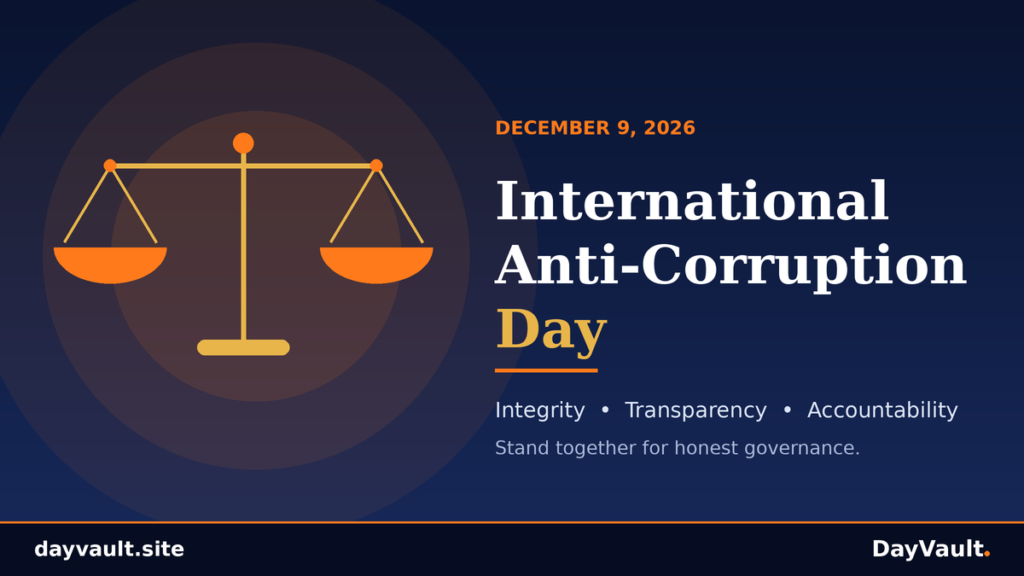
Corruption can quietly damage a society by weakening public trust, diverting money from essential services, and allowing unfair advantages to replace equal opportunities. From bribery in everyday transactions to the misuse of public funds, its effects can reach schools, hospitals, businesses, courts, and government institutions. Addressing corruption is therefore essential for building a fairer and more accountable world.
International Anti-Corruption Day is observed every year on December 9 to raise awareness about corruption and encourage action to prevent it. The day highlights the importance of honesty, transparency, accountability, and cooperation between governments, businesses, and citizens.
In 2026, the observance continues to focus global attention on the connections between corruption and crime. The United Nations campaign for 2026–2027 highlights the theme of exposing these connections and following illicit financial flows to support justice.
Whether you are a student, teacher, business owner, public servant, or concerned citizen, this day offers an opportunity to understand how corruption affects everyday life and what people can do to help prevent it.
What Is International Anti-Corruption Day?
International Anti-Corruption Day is a global observance established by the United Nations to highlight the harmful effects of corruption and promote efforts to prevent it. It encourages individuals and institutions to support ethical behaviour, responsible leadership, and fair systems.
The day is not simply about exposing wrongdoing. It is also about strengthening the systems that make corruption harder to commit and easier to detect.
Corruption occurs in different forms and can affect both public and private organizations. It may involve offering or accepting bribes, misusing public resources, manipulating contracts, favouring relatives in recruitment, or using an official position for personal benefit.
According to Transparency International, corruption involves the abuse of entrusted power for private gain. Its consequences can include weaker institutions, greater inequality, reduced economic development, and declining public confidence.
International Anti-Corruption Day reminds the world that preventing these problems requires more than punishment after wrongdoing occurs. Strong institutions, transparent procedures, independent oversight, and an informed public are also essential.
When Is International Anti-Corruption Day Celebrated?
International Anti-Corruption Day is celebrated annually on December 9.
In 2026, it falls on Wednesday, December 9.
The United Nations General Assembly designated this date in 2003 as part of its efforts to raise awareness of corruption and the international framework established to combat it. The observance takes place worldwide, although the activities and public campaigns may vary between countries.
Governments, civil society organizations, educational institutions, businesses, and community groups can use the occasion to organize awareness campaigns, discussions, educational events, and initiatives promoting integrity.
The date also provides an opportunity for individuals to reflect on their own responsibilities. Simple choices, such as refusing to offer bribes, following fair procedures, and reporting suspected wrongdoing through appropriate channels, can support a culture of accountability.
History of International Anti-Corruption Day
The history of International Anti-Corruption Day is closely connected to international efforts to establish common standards for preventing and addressing corruption.
On October 31, 2003, the United Nations General Assembly adopted the United Nations Convention against Corruption, commonly known as UNCAC, through Resolution 58/4. The General Assembly also designated December 9 as International Anti-Corruption Day. The convention entered into force in December 2005.
The convention created an important international framework for cooperation in areas such as corruption prevention, criminalization, international assistance, and the recovery of assets obtained through corruption.
Its significance extends beyond individual cases of bribery. It recognizes that corruption can cross national borders, involve complex financial networks, and require cooperation between different jurisdictions.
Over time, International Anti-Corruption Day has become an opportunity to renew public commitment to integrity and encourage stronger action against corruption.
The observance also highlights the importance of involving different parts of society. Governments have responsibilities to establish and enforce laws, businesses must maintain ethical practices, and citizens need opportunities to participate in public life and hold institutions accountable.
Why Is International Anti-Corruption Day Important?
Corruption is not merely a financial or legal problem. It can affect people’s ability to access basic services, receive fair treatment, and participate in society.
International Anti-Corruption Day is important for several reasons.
1. It Raises Public Awareness
Many people recognize bribery as corruption but may overlook other forms, such as conflicts of interest, favouritism, misuse of public property, or manipulation of procurement processes.
Awareness helps people understand how these practices occur and why they should not be treated as normal or unavoidable.
Educational campaigns can also explain how to recognize suspicious conduct, find reliable information, and use appropriate complaint mechanisms.
2. It Promotes Transparency and Accountability
Transparency means that decisions, procedures, and the use of resources can be examined by the people who have a legitimate interest in them.
Accountability means that individuals and institutions must explain their decisions and face appropriate consequences when they violate rules.
These principles are especially important when public money is involved. Clear procurement procedures, reliable financial records, independent audits, and accessible public information can help reduce opportunities for corruption.
3. It Protects Public Resources
Money lost through corruption could otherwise support essential services and development projects.
When public funds are misused, communities may receive lower-quality infrastructure, delayed projects, inadequate services, or less value for the money spent.
Preventing corruption helps protect the resources intended for public benefit and encourages more responsible spending.
4. It Supports Fairness and Equal Opportunities
Corruption can give unfair advantages to people who have money, influence, or personal connections.
For example, a qualified applicant may lose an opportunity because someone else has paid a bribe or received preferential treatment.
Fair recruitment, impartial decision-making, and equal application of rules help create a society in which opportunities depend on legitimate qualifications and transparent procedures.
5. It Strengthens Trust in Institutions
People are more likely to trust institutions when they believe decisions are made fairly and complaints are handled properly.
When corruption goes unaddressed, public confidence can decline. People may become reluctant to seek services, report wrongdoing, or participate in civic activities.
International Anti-Corruption Day encourages institutions to earn trust through consistent ethical conduct rather than relying on promises alone.
What Is the Theme of International Anti-Corruption Day 2026?
The United Nations campaign for International Anti-Corruption Day 2026–2027 uses the theme “Connecting the Dots: Exposing the Links Between Corruption and Crime.”
The campaign focuses on how corruption can help criminal networks operate, conceal illegal profits, and avoid detection.
Corruption may enable organized crime by allowing individuals or groups to influence officials, bypass legal safeguards, or gain access to confidential information. Illicit financial networks can also be used to hide and reinvest proceeds from criminal activities.
These connections make corruption an international concern rather than a problem limited to one institution or country.
The campaign emphasizes several priorities:
- Following illicit money: Strengthening financial transparency and improving the ability to trace suspicious financial flows.
- Improving international cooperation: Helping countries exchange information and work together on cross-border investigations.
- Strengthening accountability: Ensuring that institutions can identify misconduct and respond appropriately.
- Protecting public resources: Reducing opportunities for criminal networks to exploit government systems and legitimate businesses.
- Preventing crime: Addressing weaknesses that allow corruption to support wider criminal activity.
The campaign also encourages governments, businesses, and communities to recognize that preventing corruption can support security, justice, and sustainable development.
Common Types of Corruption
Understanding the different forms of corruption helps people recognize the problem and respond more effectively.
Bribery
Bribery occurs when money, gifts, favours, or other benefits are offered, requested, or accepted to influence a decision improperly.
For example, someone might offer an unofficial payment to receive a permit faster or avoid a lawful penalty.
Embezzlement and Misuse of Funds
Embezzlement involves the dishonest appropriation of money or property entrusted to someone.
This can happen when an employee diverts organizational funds for personal use or when resources allocated for a public project are misused.
Nepotism and Favouritism
Nepotism involves giving unfair advantages to relatives, while favouritism involves preferential treatment based on personal relationships or other improper considerations.
These practices can undermine fair recruitment, weaken organizations, and discourage qualified people from applying for opportunities.
Abuse of Power
Abuse of power occurs when someone uses an official role or position improperly for personal benefit or to disadvantage others.
This can include pressuring employees, interfering with fair procedures, or using authority to secure benefits that are not legitimately available.
Fraud and Procurement Manipulation
Fraud involves deception intended to secure an improper benefit. In procurement, corruption risks may arise through manipulated tenders, undisclosed conflicts of interest, or collusion between bidders and decision-makers.
Such practices can increase costs, reduce competition, and compromise the quality of goods and services.
Not every administrative mistake or unfair outcome is necessarily corruption. Establishing wrongdoing requires examining the facts, applicable rules, and available evidence.
How Does Corruption Affect Everyday Life?
Corruption can seem like a distant issue involving powerful individuals or large financial transactions. In reality, its effects can reach ordinary households and local communities.
Education: Corruption in education can undermine fair admissions, recruitment, examinations, and the distribution of school resources. Students may lose opportunities when decisions are influenced by improper payments or personal connections.
Healthcare: Misuse of healthcare budgets, bribery, or dishonest procurement can interfere with the fair distribution of medical supplies and the delivery of reliable services.
Business and employment: Companies may face unfair competition when contracts depend on bribery rather than quality and value. Job applicants may also lose opportunities through favouritism.
Infrastructure: Corruption risks in construction and public procurement can result in wasted resources, poor-quality work, and reduced value for public spending.
Justice and public safety: When officials improperly influence investigations or legal decisions, people may lose confidence that laws are applied equally.
Economic development: Corruption can discourage responsible investment, create uncertainty for businesses, and divert resources away from productive activities.
These examples demonstrate why preventing corruption is connected to improving everyday life. Fair systems help ensure that resources, services, and opportunities are distributed according to legitimate rules rather than improper influence.
How Can Individuals Help Fight Corruption?
Governments and institutions have major responsibilities, but individuals can also contribute to a culture of integrity.
Here are practical steps people can take.
- Refuse to participate in bribery. Avoid offering unofficial payments or benefits to influence decisions. Where safe and appropriate, seek lawful alternatives.
- Learn the rules. Understanding official procedures, fees, eligibility requirements, and complaint channels makes it easier to identify suspicious requests.
- Keep accurate records. Retain receipts, correspondence, and relevant documents when dealing with public or private institutions.
- Report suspected wrongdoing responsibly. Use official reporting channels, ombudsman services, regulators, or other appropriate bodies. Follow local laws and consider personal safety.
- Verify information before sharing it. Avoid spreading unverified allegations online. Responsible reporting should be based on credible evidence.
- Support transparency. Encourage clear procedures, fair selection processes, proper recordkeeping, and responsible use of public resources.
- Practise integrity at work and at school. Do not cheat, falsify records, misuse organizational property, or seek unfair advantages through personal connections.
- Encourage civic participation. Learn about public decisions, attend community discussions where possible, and support legitimate efforts to improve accountability.
Individual actions cannot replace effective institutions or law enforcement. However, everyday choices can reinforce ethical standards and make it more difficult for corrupt practices to become socially accepted.
How Can Schools, Businesses, and Governments Observe the Day?
International Anti-Corruption Day offers organizations an opportunity to turn awareness into practical commitments.
Schools and Educational Institutions
Teachers and students can organize activities that explain honesty, fairness, responsible leadership, and the consequences of corruption.
Useful ideas include:
- Holding classroom discussions about ethical decision-making.
- Organizing poster-making and essay-writing competitions.
- Using fictional case studies to explore bribery and favouritism.
- Conducting debates about transparency and public responsibility.
- Encouraging students to develop an integrity pledge.
These activities help young people understand that integrity is demonstrated through decisions and behaviour, not merely words.
Businesses and Organizations
Companies can use the occasion to review their ethical standards and strengthen internal safeguards.
Possible actions include reviewing anti-bribery policies, training employees, improving procurement procedures, disclosing conflicts of interest, and providing confidential reporting mechanisms where appropriate.
Leaders should also ensure that employees can raise concerns without unfair retaliation.
Governments and Public Institutions
Public institutions can promote the day by explaining how citizens can access services, submit complaints, and obtain relevant public information.
They can also review internal controls, improve financial reporting, strengthen independent oversight, and assess whether existing safeguards are working effectively.
Public awareness campaigns are most valuable when they accompany practical improvements in institutional behaviour.
Communities and Civil Society
Community organizations can host discussions, share educational materials, and explain lawful ways to report concerns.
Journalists and civil society groups can contribute by examining evidence, explaining complex issues clearly, and helping the public understand how institutions are held accountable.
Meaningful observance should go beyond a single day’s activities. It should encourage lasting improvements in transparency and ethical conduct.
The Role of Young People in Preventing Corruption
Young people have an important role in shaping future attitudes toward honesty, fairness, and public responsibility.
Students can begin by practising academic integrity, rejecting cheating, respecting fair procedures, and speaking responsibly about misconduct.
They can also use digital platforms to share reliable educational resources, explain the importance of accountability, and encourage constructive conversations.
Schools, universities, and youth organizations can create opportunities for young people to discuss ethical dilemmas and propose practical solutions to community problems.
Young people should also understand that challenging corruption does not require taking unsafe personal risks. Concerns should be raised through suitable channels, and allegations should be handled carefully and fairly.
By developing critical thinking, digital literacy, and a strong understanding of civic responsibility, young people can help build communities where dishonesty is challenged rather than normalized.
International Anti-Corruption Day: Ways to Spread Awareness
You do not need to organize a large event to participate. Small, thoughtful activities can help people understand why corruption matters.
Consider these ideas for December 9:
- Share educational information about corruption and its consequences.
- Publish a short article explaining transparency and accountability.
- Create an awareness poster for a school, workplace, or community centre.
- Organize a discussion about ethical leadership and fair decision-making.
- Share information about legitimate complaint and reporting mechanisms.
- Encourage organizations to review their codes of conduct.
- Use social media to promote responsible citizenship and integrity.
If you are creating online content, use accurate information and link to reliable sources, particularly official United Nations resources.
The 2026–2027 campaign also provides an opportunity to explain how corruption can enable crime and why following illicit financial flows matters. Using the official campaign information can help ensure that awareness messages reflect the current international focus.
Frequently Asked Questions (FAQs)
1. When is International Anti-Corruption Day celebrated?
International Anti-Corruption Day is observed every year on December 9. In 2026, it falls on Wednesday, December 9. The United Nations established the observance to raise awareness of corruption and support international efforts to prevent it.
2. Why do we celebrate International Anti-Corruption Day?
The day raises awareness about the harmful effects of corruption and promotes transparency, accountability, integrity, and justice. It also encourages governments, businesses, educational institutions, and individuals to take practical steps to prevent corrupt practices.
3. What is the theme of International Anti-Corruption Day 2026?
The United Nations campaign for 2026–2027 is titled “Connecting the Dots: Exposing the Links Between Corruption and Crime.” It highlights how corruption can enable criminal networks, conceal illegal profits, and undermine justice and public security.
4. Who established International Anti-Corruption Day?
The United Nations General Assembly designated December 9 as International Anti-Corruption Day in 2003, alongside the adoption of the United Nations Convention against Corruption. The convention entered into force in December 2005.
5. How can students participate in International Anti-Corruption Day?
Students can participate by organizing awareness posters, classroom discussions, essay competitions, debates, and social media campaigns based on reliable information. They can also promote academic honesty, reject cheating, and learn how transparency and accountability help create fairer communities.
Conclusion
International Anti-Corruption Day is an important reminder that corruption affects more than government offices or financial institutions. It can undermine education, healthcare, employment, public services, economic development, and trust in the systems people depend on.
Observed every year on December 9, the day encourages people around the world to promote integrity, strengthen accountability, and support effective measures against corruption. The 2026–2027 United Nations campaign further highlights the connection between corruption and crime, emphasizing the importance of financial transparency and international cooperation.
Lasting progress requires strong laws, independent oversight, responsible leadership, and institutions that act fairly. It also depends on individuals who refuse to normalize dishonesty and choose to act responsibly in their daily lives.
By raising awareness, supporting transparent systems, and encouraging ethical behaviour, we can all contribute to a society where decisions are fairer, public resources are better protected, and people can place greater trust in the institutions that serve them.
1. When is International Anti-Corruption Day celebrated?
International Anti-Corruption Day is observed every year on December 9 to raise awareness about corruption and promote transparency, accountability, and integrity worldwide.
2. Why is International Anti-Corruption Day important?
International Anti-Corruption Day is important because it highlights the harmful effects of corruption on society, public services, economic development, and justice. It encourages people and institutions to take action against corrupt practices.
3. What is the theme of International Anti-Corruption Day 2026?
The United Nations campaign for 2026–2027 is titled “Connecting the Dots: Exposing the Links Between Corruption and Crime.” It focuses on the relationship between corruption, criminal networks, and illicit financial flows.
4. Who established International Anti-Corruption Day?
The United Nations General Assembly designated December 9 as International Anti-Corruption Day in 2003, alongside the adoption of the United Nations Convention against Corruption.
5. What are the common types of corruption?
Common types of corruption include bribery, embezzlement, nepotism, favouritism, abuse of power, fraud, and the misuse of public resources for personal gain.
6. How does corruption affect society?
Corruption can weaken public institutions, increase inequality, waste public funds, reduce trust in government, and limit access to essential services such as education and healthcare.
7. How can students participate in International Anti-Corruption Day?
Students can participate by organizing awareness campaigns, creating posters, writing essays, joining classroom discussions, promoting academic honesty, and sharing reliable information about corruption prevention.
8. How can individuals help prevent corruption?
Individuals can help prevent corruption by refusing bribes, following lawful procedures, keeping accurate records, reporting suspected wrongdoing through appropriate channels, and promoting honesty and accountability.
9. What is the United Nations Convention against Corruption?
The United Nations Convention against Corruption is an international agreement adopted in 2003 that provides a framework for preventing corruption, addressing corrupt offences, promoting international cooperation, and recovering assets obtained through corruption.
10. What is the main purpose of International Anti-Corruption Day?
The main purpose is to increase global awareness of corruption, encourage collective action, and promote transparent, accountable, and ethical practices in governments, businesses, and communities.
