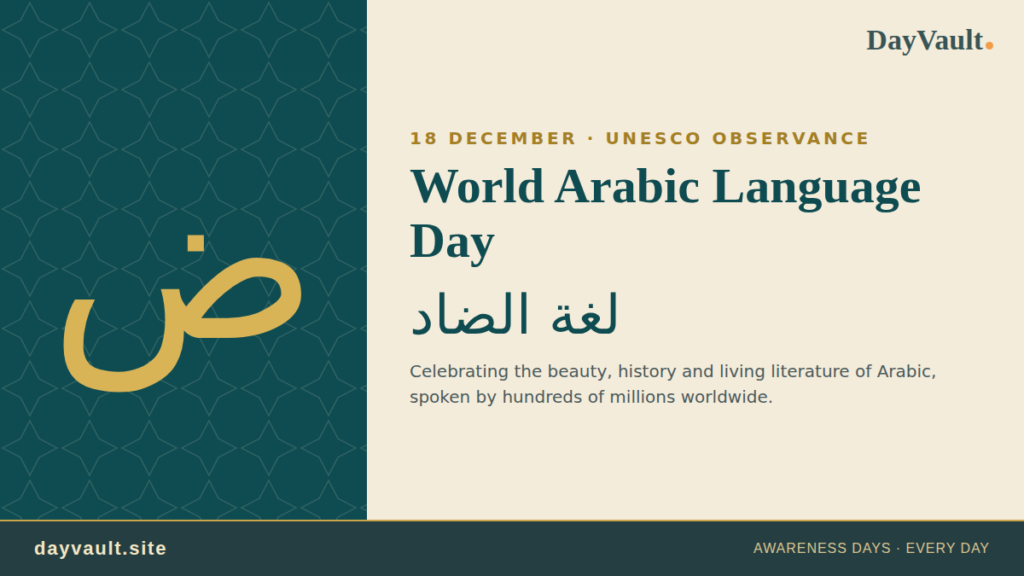
Arabic is more than a language. It is a bridge between generations, a treasure of literature, a language of scholarship, and an important part of the cultural identity of millions of people around the world. From the beauty of Arabic calligraphy to the poetry, stories, and scientific works written over centuries, Arabic continues to influence how people communicate, learn, and understand different cultures.
World Arabic Language Day is celebrated every year on December 18 to recognize the importance of Arabic and promote linguistic and cultural diversity. The occasion provides an opportunity to explore the language’s history, appreciate its artistic traditions, and understand its continuing role in education, literature, science, and international communication.
In 2026, World Arabic Language Day falls on Friday, December 18. Whether you speak Arabic fluently, are learning it as a second language, or simply want to discover more about world cultures, this observance offers a meaningful reason to explore one of the world’s most influential languages.
What Is World Arabic Language Day?
World Arabic Language Day is an annual international observance that celebrates the Arabic language and its cultural, historical, intellectual, and social contributions.
The day is associated with the United Nations Educational, Scientific and Cultural Organization (UNESCO), which promotes international cooperation in education, science, culture, and communication. The observance encourages people to appreciate Arabic as a language of expression, creativity, knowledge, and cultural heritage.
Arabic has a rich literary tradition and an important place in religious, philosophical, scientific, and artistic history. It is also a living language used in everyday conversations, education, media, business, and public life across many countries.
World Arabic Language Day highlights several important goals:
- Promoting awareness of Arabic’s global significance.
- Celebrating Arabic literature, poetry, calligraphy, and artistic traditions.
- Encouraging multilingualism and cultural exchange.
- Supporting the preservation and development of the Arabic language.
- Inspiring younger generations to learn about Arabic and its heritage.
The occasion is not limited to Arabic-speaking communities. Anyone interested in languages, history, literature, or cultural diversity can participate.
When Is World Arabic Language Day Celebrated?
World Arabic Language Day is celebrated annually on December 18.
The date commemorates an important moment in international history. On December 18, 1973, the United Nations General Assembly adopted Arabic as one of the official languages of the United Nations.
UNESCO later established World Arabic Language Day in 2012, and the first celebration took place on December 18 that year.
The choice of date connects the observance directly to the international recognition of Arabic and its role in diplomacy, cooperation, and global communication.
Here are the key details:
- Occasion: World Arabic Language Day
- Date: December 18 every year
- 2026 date: Friday, December 18, 2026
- Established by: UNESCO
- First celebration: 2012
- Main purpose: To celebrate Arabic and promote linguistic and cultural diversity
Unlike holidays that change dates according to the lunar calendar, this observance takes place on the same Gregorian calendar date every year.
History and Origins of World Arabic Language Day
The history of World Arabic Language Day is closely connected to the growing recognition of linguistic diversity in international institutions.
Arabic becomes an official UN language
The United Nations uses official languages to support communication among member states and make international discussions accessible to a wide range of countries.
In 1973, the General Assembly adopted Arabic as an official language. This decision recognized the importance of Arabic-speaking countries in international affairs and strengthened the language’s place in multilateral diplomacy.
Arabic joined the other official languages of the United Nations, allowing it to be used in official meetings, documents, and communications under the organization’s language arrangements.
UNESCO establishes the annual observance
In 2012, UNESCO introduced World Arabic Language Day as part of its wider efforts to celebrate multilingualism and cultural diversity.
December 18 was selected because of its connection to the 1973 United Nations decision.
Since then, the observance has provided a platform for educational activities, cultural programs, literary discussions, exhibitions, and conversations about the future of Arabic.
Each celebration can highlight different aspects of the language, including its history, contemporary use, technological development, and contribution to cultural exchange.
The day also reminds the international community that languages are not simply tools for speaking and writing. They preserve knowledge, carry traditions, and help people maintain connections with their communities and histories.
Why Is the Arabic Language Important?
Arabic holds significance in several areas of human life, from everyday communication to literature, religious practice, science, and international relations.
1. A language with a rich cultural heritage
Arabic has a long and influential literary history. Generations of writers, poets, scholars, and storytellers have used it to express emotions, explore philosophical questions, record historical events, and share knowledge.
Arabic poetry, prose, historical writing, and storytelling traditions continue to influence literature and artistic expression.
The language also carries regional traditions, local expressions, and family histories. For many communities, Arabic provides a connection to their roots and a way to pass cultural knowledge from one generation to the next.
2. A language of religious and intellectual tradition
Arabic has a central place in Islam because the Quran is written in Arabic. It is also used extensively in Islamic scholarship, religious education, and traditional forms of worship.
Beyond religion, Arabic has played a major role in intellectual history. During different periods of history, Arabic-speaking scholars contributed to mathematics, astronomy, medicine, philosophy, geography, and other fields.
Their works helped preserve, develop, and circulate knowledge across different societies.
This legacy demonstrates how languages can support intellectual exchange and contribute to the advancement of human understanding.
3. An important language of international communication
Arabic is one of the six official languages of the United Nations. It is used in diplomacy, international discussions, official documentation, and communication involving Arabic-speaking countries.
Arabic also plays a role in international journalism, education, commerce, tourism, and cultural relations.
Learning Arabic can help students, researchers, professionals, and travelers communicate with a wider range of people and better understand the societies in which the language is spoken.
4. A connection between generations
Languages preserve more than vocabulary and grammar. They also carry memories, humor, traditions, values, and ways of seeing the world.
Arabic allows families and communities to pass down stories, proverbs, songs, poetry, and traditional knowledge.
Preserving and teaching Arabic can help younger generations maintain connections with their heritage while developing the skills needed to participate in a changing world.
Interesting Facts About the Arabic Language
World Arabic Language Day is a wonderful opportunity to discover some fascinating features of Arabic.
Arabic is written from right to left
Arabic is written from right to left, which distinguishes its writing direction from English and many other languages.
Its script is connected, meaning that most letters join one another within a word. The shape of a letter can change depending on whether it appears at the beginning, middle, or end of a word.
This connected structure gives Arabic writing its distinctive visual character.
Arabic has a rich system of word formation
Arabic uses patterns and roots to form many related words. A root often contains three consonants, although other patterns also exist.
Different patterns can express related ideas, actions, people, or qualities. This system contributes to the language’s flexibility and depth.
Arabic has many regional varieties
Arabic is spoken in many countries, and its spoken forms differ from region to region.
People may use different vocabulary, pronunciation, and expressions in Morocco, Egypt, Lebanon, Saudi Arabia, Iraq, and other places.
Modern Standard Arabic is widely used in formal writing, news, education, and official communication. Everyday conversation, however, commonly involves regional varieties.
These differences reflect the diversity of Arabic-speaking communities rather than a lack of connection between them.
Arabic has influenced other languages
Arabic has contributed words to numerous languages through trade, travel, scholarship, migration, and cultural contact.
English words such as algebra, algorithm, and coffee have historical connections to Arabic or Arabic-mediated transmission. Their individual etymologies differ, but together they illustrate the language’s broad influence.
Arabic calligraphy is an art form
Arabic calligraphy transforms written language into visual art. Calligraphers pay close attention to proportion, line, spacing, and the relationship between letters.
Calligraphy appears in manuscripts, architecture, decorative objects, and contemporary artwork. It demonstrates how writing can serve both practical and artistic purposes.
How Is World Arabic Language Day Celebrated?
People celebrate World Arabic Language Day in different ways depending on their interests, communities, and access to educational or cultural activities.
Schools, universities, libraries, cultural organizations, and language learners can all participate.
1. Organize Arabic language activities
Teachers and students can arrange classroom activities that introduce Arabic letters, common greetings, vocabulary, and basic expressions.
Activities can include language games, pronunciation practice, short presentations, and quizzes about Arabic-speaking countries.
These exercises help make language learning engaging and accessible to beginners.
2. Explore Arabic literature and poetry
Reading Arabic poetry, short stories, or translated literary works is another meaningful way to celebrate.
Readers can explore classical poetry alongside contemporary Arabic writers to discover how the language has developed over time.
Comparing an original Arabic text with its translation can also reveal how imagery, rhythm, and cultural references influence literary meaning.
3. Appreciate Arabic calligraphy
Art workshops can introduce participants to the visual beauty of Arabic script.
Beginners might practice writing their names in Arabic, learn about different calligraphic styles, or create artwork inspired by Arabic letters.
Anyone organizing a workshop should respect the cultural and religious context of particular inscriptions, especially when using sacred texts.
4. Attend cultural events
Community centers, libraries, universities, and cultural institutions may organize exhibitions, lectures, performances, or discussions related to Arabic language and heritage.
Participants can learn about Arabic music, storytelling, architecture, literature, and the different traditions found across Arabic-speaking regions.
Such events encourage people to appreciate cultural diversity without reducing Arabic-speaking societies to a single identity or tradition.
5. Learn a few Arabic phrases
Language learners can mark the occasion by learning simple expressions.
Here are a few examples:
- Marhaban (مرحبًا): Hello.
- Shukran (شكرًا): Thank you.
- Min fadlik (من فضلك): Please, when addressing a male; usage varies with context.
- Ma’a as-salama (مع السلامة): Goodbye.
Pronunciation and everyday usage may vary across Arabic-speaking communities, but learning a few expressions can be a useful starting point.
6. Share educational content online
Social media can help spread awareness of World Arabic Language Day.
Individuals and organizations can share facts about Arabic, introduce notable writers, publish calligraphy artwork, recommend books, or explain the significance of December 18.
Schools can also encourage students to create short videos, posters, or presentations about the language.
The most valuable content is accurate, respectful, and informative rather than based on stereotypes.
World Arabic Language Day and Cultural Diversity
Language is closely connected to identity, community, and cultural memory. When people use their languages, they share not only information but also experiences, values, and traditions.
World Arabic Language Day supports the broader idea that linguistic diversity deserves recognition and respect.
Arabic-speaking communities are culturally and geographically diverse. Their histories, food, music, literature, customs, and spoken varieties differ across regions. Celebrating Arabic should therefore involve recognizing this diversity rather than assuming that all Arabic speakers share identical experiences.
The observance also creates opportunities for dialogue between people who speak different languages.
Learning about another language can help reduce misunderstandings, challenge stereotypes, and build appreciation for different cultural perspectives.
These benefits extend beyond Arabic. Every language contributes to humanity’s collective heritage, and efforts to preserve linguistic diversity help keep knowledge and traditions accessible to future generations.
Challenges Facing the Arabic Language Today
Although Arabic remains widely spoken and culturally influential, it faces challenges in some educational, technological, and social settings.
Understanding these challenges helps explain why language promotion and preservation remain important.
Maintaining Arabic in digital spaces
Technology has transformed how people read, write, study, and communicate. Arabic is used across digital platforms, but the quality and availability of Arabic-language resources can vary.
Developing accessible educational materials, digital libraries, translation tools, and language technologies can help more people use Arabic online.
Accurate support for Arabic script, spelling, grammar, and regional varieties is especially important as artificial intelligence and digital communication continue to develop.
Encouraging reading and writing
In some communities, young people use regional spoken Arabic, Modern Standard Arabic, and other languages in different settings.
Helping students develop confidence in formal Arabic reading and writing can support educational achievement and cultural engagement.
Schools, families, libraries, and publishers can encourage reading through age-appropriate books, engaging stories, and access to diverse literary works.
Preserving regional varieties
Regional Arabic varieties carry important local histories, expressions, and cultural knowledge.
Documenting oral traditions, recording community stories, and supporting research can help preserve linguistic features that might otherwise receive less attention.
Preservation does not require rejecting linguistic change. Languages naturally evolve, and both traditional and contemporary forms can contribute to a living cultural heritage.
Making language learning accessible
People learn Arabic for many reasons, including education, family connections, travel, professional development, and religious study.
Affordable courses, well-designed learning materials, accessible digital resources, and opportunities for conversation can help more learners develop their skills.
World Arabic Language Day provides a useful reminder that language education should encourage curiosity and participation at every age.
How Students and Teachers Can Mark the Day
Educational institutions can turn World Arabic Language Day into a practical learning experience.
Rather than limiting the occasion to a speech or a poster, teachers can organize activities that combine research, creativity, and communication.
Suggested classroom activities include:
- Arabic alphabet workshop: Introduce the script and let students practice writing selected letters.
- Cultural research presentations: Assign students different Arabic-speaking countries to explore their languages, literature, and cultural traditions.
- Poetry reading: Share short Arabic poems alongside translations and discuss their themes.
- Calligraphy exhibition: Display student artwork inspired by Arabic lettering.
- Language quiz: Prepare questions about Arabic history, geography, writing, and international recognition.
- Reading corner: Recommend Arabic books, bilingual stories, and reliable learning resources.
- Digital awareness campaign: Ask students to create fact-based posts explaining why Arabic matters.
These activities can be adapted for different ages and experience levels. The goal is to make learning interactive while encouraging respect for linguistic and cultural differences.
The Future of the Arabic Language
The future of Arabic will be shaped by education, technology, literature, international communication, and the choices of the people who use it every day.
Digital publishing and online learning have created new opportunities for Arabic speakers and learners to access books, courses, news, and educational resources. Language technologies can also help people translate content, explore vocabulary, and communicate across linguistic boundaries.
At the same time, meaningful progress requires careful attention to the diversity of Arabic. Resources that focus only on formal language may not fully reflect the needs of people communicating in regional varieties. Likewise, digital tools need to handle Arabic script and linguistic structures accurately.
Writers, teachers, researchers, developers, cultural organizations, and families all have a role in supporting the language.
By encouraging reading, preserving literary heritage, creating useful digital resources, and making language education accessible, communities can help Arabic continue to develop while maintaining connections with its history.
World Arabic Language Day offers an annual opportunity to recognize this work and consider how individuals and institutions can contribute to the language’s future.
Frequently Asked Questions
1. When is World Arabic Language Day celebrated?
World Arabic Language Day is celebrated every year on December 18. In 2026, it falls on Friday, December 18. The date commemorates the United Nations General Assembly’s 1973 decision to adopt Arabic as an official UN language.
2. Why is World Arabic Language Day celebrated?
The day celebrates Arabic’s historical, cultural, literary, and intellectual contributions. It also promotes multilingualism, cultural diversity, language learning, and greater appreciation of Arabic around the world.
3. Who established World Arabic Language Day?
UNESCO established World Arabic Language Day in 2012. The first celebration took place on December 18, 2012, using the anniversary of Arabic’s adoption as an official UN language as the annual date.
4. Why is Arabic important in the world today?
Arabic is important in international diplomacy, education, literature, religious traditions, media, and cultural exchange. It connects diverse communities and provides access to a substantial body of historical and contemporary knowledge.
5. How can students celebrate World Arabic Language Day?
Students can celebrate by learning basic Arabic phrases, practicing the alphabet, reading Arabic literature in translation, exploring calligraphy, researching Arabic-speaking countries, or organizing a classroom presentation about the language’s history and importance.
Conclusion
World Arabic Language Day is an opportunity to celebrate a language that has shaped literature, scholarship, cultural traditions, and international communication for centuries. Observed every year on December 18, it recognizes Arabic’s official place in the United Nations and highlights the importance of preserving and promoting linguistic diversity.
The occasion can be marked through simple but meaningful activities, including reading Arabic literature, learning basic phrases, appreciating calligraphy, and participating in educational or cultural events.
Its message extends beyond one language: every language carries knowledge, identity, and human experience worth preserving. By learning about Arabic and respecting the diversity of its speakers, people can contribute to greater cultural understanding and a more connected world.
On December 18, 2026, take a moment to discover something new about Arabic, share its rich heritage, or encourage someone to begin learning the language. Even a small step can help keep curiosity, cultural appreciation, and language learning alive.
Q1. When is World Arabic Language Day celebrated?
World Arabic Language Day is celebrated every year on December 18. In 2026, it falls on Friday, December 18.
Q2. Why is World Arabic Language Day celebrated?
World Arabic Language Day celebrates the Arabic language, its rich cultural heritage, literary traditions, and contributions to science, education, and international communication.
Q3. Who established World Arabic Language Day?
UNESCO established World Arabic Language Day in 2012, and the first celebration took place on December 18, 2012.
Q4. Why is December 18 important for the Arabic language?
December 18 marks the date in 1973 when the United Nations General Assembly adopted Arabic as one of the organization’s official languages.
Q5. What is the main purpose of World Arabic Language Day?
The main purpose is to promote Arabic, encourage multilingualism, celebrate cultural diversity, and raise awareness of the language’s global significance.
Q6. How can people celebrate World Arabic Language Day?
People can celebrate by learning Arabic phrases, reading Arabic literature, appreciating calligraphy, attending cultural events, and sharing educational information about the language.
Q7. How many people speak Arabic worldwide?
Arabic is spoken by hundreds of millions of people worldwide, including native speakers and people who use it as an additional language.
Q8. Why is Arabic important in international communication?
Arabic is one of the six official languages of the United Nations and plays an important role in diplomacy, education, media, trade, and cultural exchange.
Q9. What are some interesting facts about the Arabic language?
Arabic is written from right to left, has a distinctive connected script, includes many regional varieties, and has influenced vocabulary in numerous other languages.
Q10. How can students participate in World Arabic Language Day?
Students can participate by practicing Arabic writing, researching Arabic-speaking countries, presenting facts about Arabic history, reading poetry, or creating educational posters.
