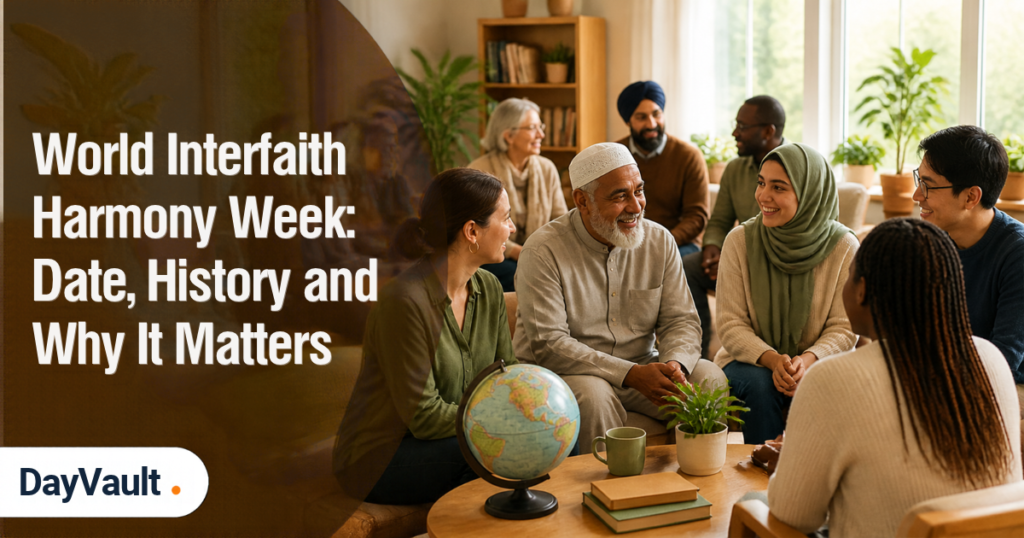
Every year, in the first days of February, the United Nations calendar makes room for something simple but rarely easy: people of different faiths and beliefs choosing to listen to one another. World Interfaith Harmony is observed as a full week rather than a single day. It invites everyone, believers and non believers alike, to look for common ground.
This guide explains when the week takes place, how it began, what it is meant to achieve, and how ordinary people, schools and communities can take part.
When Is World Interfaith Harmony Week?
World Interfaith Harmony Week is observed every year from 1 to 7 February. The dates are fixed, so they do not shift from year to year. In 2027 the week runs from Monday, 1 February to Sunday, 7 February.
It is not a public holiday anywhere that we can verify, and it is not a day off work or school. It is an international observance week, so participation depends on schools, faith communities, civil society groups and individuals.
What Is World Interfaith Harmony Week?
World Interfaith Harmony Week is an annual observance created by the United Nations General Assembly. Its purpose is to promote mutual understanding, respect and goodwill between people of different religions and beliefs.
The idea is practical rather than abstract. The week encourages people to move beyond tolerance as a passive attitude and toward real contact: conversation, shared service and honest curiosity. Interfaith harmony does not ask anyone to give up their own beliefs or to pretend that differences do not exist. It asks people to treat each other with dignity while those differences remain.
History and Origin
The week has a clear and well documented starting point in the UN system.
In September 2010, King Abdullah II of Jordan proposed the observance at the UN General Assembly. The proposal drew on earlier Jordanian led interfaith efforts, including the 2007 open letter known as A Common Word Between Us and You. That letter, written by Muslim scholars and addressed to Christian leaders, pointed to love of God and love of neighbour as shared teachings of the two faiths.
On 20 October 2010, the General Assembly adopted Resolution 65/5, which established World Interfaith Harmony Week as an annual observance in the first week of February. The resolution invited all countries to support the spread of a message of interfaith harmony and goodwill during that week, in places of worship and beyond.
Two details of the wording are worth noting because most websites overlook them.
- It names many places of worship. The resolution refers to churches, mosques, synagogues, temples and other places of worship, so the observance was never meant to belong to one tradition.
- It includes people without a religion. Alongside the love of God and love of neighbour, the text also speaks of love of the good and love of neighbour. This phrase gives non religious and humanist communities a place in the observance.
Why Is World Interfaith Harmony Celebrated?
The observance exists because misunderstanding between religious communities has often fed mistrust, discrimination and conflict. Meeting across faith lines is one of the most direct ways to reduce that mistrust.
The week is built on a few simple convictions:
- Most major traditions teach compassion, justice and care for neighbours.
- People are less likely to fear those they know personally.
- Peace within societies depends on everyone feeling respected, whatever they believe.
- Shared action on common problems often works better than debate alone.
Significance and Importance
Many societies today are religiously mixed. Neighbours, classmates and colleagues often follow different faiths or none at all. Interfaith harmony is therefore not a distant diplomatic goal. It shapes everyday life in schools, workplaces, hospitals and local communities.
The week also reminds people that religion can be a force for cooperation. Interfaith groups around the world have worked together on food distribution, disaster relief, education and community support. These efforts show that faith communities can combine their strengths for the common good.
Finally, the week keeps an important question in public view: how can people with deep differences live together well? The question does not have a single answer, but asking it regularly is part of the work.
How Is It Observed Around the World?
Because the week has no single required format, observance varies widely. Common approaches include:
- Interfaith gatherings and dialogues, where representatives of different traditions discuss shared values and real challenges.
- Open days at places of worship, which let neighbours visit, ask questions and learn what happens inside.
- School and university activities, such as assemblies, essay projects, panel talks and cultural exhibitions.
- Joint service projects, including food drives, clean ups and volunteering days run by several faith groups together.
- Online campaigns and webinars, which connect people who could not otherwise meet.
The scale of events differs from one place to another. Some are large public programmes, while others are small gatherings in a living room or a classroom. Both count.
How to Take Part
You do not need to be part of any organisation to join in. Here are realistic ways to mark the week:
- Visit a place of worship you have never entered. Ask in advance about etiquette and the right time to come.
- Start a respectful conversation. Ask a friend or colleague what their faith or worldview means to them, then listen without arguing.
- Read beyond your own tradition. An introductory book or article about another belief system can correct many common misconceptions.
- Volunteer together. Look for a service project that welcomes people of all backgrounds.
- Teach it. Teachers can build a short lesson on shared values, different festivals or the role of respect in a diverse society.
- Share carefully online. Post accurate, respectful content and avoid stereotypes or sweeping claims about any group.
Interesting Facts
- The observance is a week, not a single day, which is unusual among UN observances.
- It was proposed by Jordan and adopted by the General Assembly in the same autumn, in 2010.
- The “love of the good” wording was included so that people without a religious affiliation could take part.
- The week overlaps with the International Day of Human Fraternity on 4 February, which gives the first week of February a strong theme of unity.
Related International Days
Several other UN observances share the same spirit, which makes them useful companions to this week:
- International Day of Human Fraternity (4 February): Marks the human family’s shared bond. It was established by the UN General Assembly in 2020.
- International Day for Tolerance (16 November): Promotes respect for diversity and mutual understanding.
- International Day of Living Together in Peace (16 May): Encourages peaceful coexistence and reconciliation.
- World Day for Cultural Diversity for Dialogue and Development (21 May): Highlights the value of cultural variety.
- International Day of Peace (21 September): Dedicated to peace within and among nations.
- International Day Commemorating the Victims of Acts of Violence Based on Religion or Belief (22 August): Remembers those targeted because of their faith or belief.
FAQs
When is World Interfaith Harmony Week?
It is observed every year from 1 to 7 February. The dates are fixed.
Who started World Interfaith Harmony Week?
King Abdullah II of Jordan proposed it at the UN General Assembly in 2010. The Assembly adopted it that October.
Is World Interfaith Harmony Week an official UN observance?
Yes. It was established by UN General Assembly Resolution 65/5 in 2010 as an annual week long observance.
Is it a public holiday?
No. It is an awareness week, so schools and workplaces generally stay open, and activities are voluntary.
Is it only for religious people?
No. The resolution includes the idea of love of the good and love of neighbour, so people with no religious affiliation are welcome to take part.
What is the difference between World Interfaith Harmony Week and the International Day of Human Fraternity?
The first is a week long observance about harmony between faiths and beliefs. The second is a single day, 4 February, about the shared bond of all people. They fall in the same week and support each other.
How can I celebrate World Interfaith Harmony Week?
Visit a place of worship, hold a respectful conversation, join a shared service project or teach a short lesson on shared values.
Conclusion
World Interfaith Harmony Week asks something modest and demanding at once: that people meet each other with respect and curiosity. This year, the week of 1 to 7 February is a good moment to take one small step across a boundary, whether by asking a question, accepting an invitation or listening more carefully than usual
