Introduction
High in the rugged mountains of Central and South Asia lives one of the world’s most mysterious wild cats: the snow leopard. With its smoky-grey fur, striking dark rosettes, powerful legs, and long, bushy tail, this remarkable animal is perfectly adapted to survive in some of the harshest mountain environments on Earth. Yet, despite its strength and ability to live in extreme conditions, the snow leopard faces serious threats to its survival.
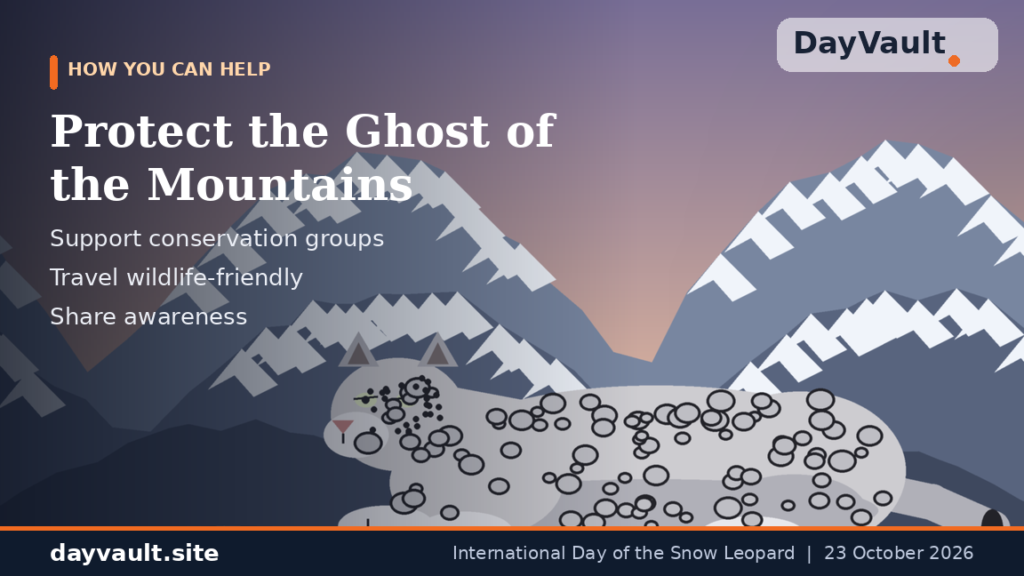
The International Day of the Snow Leopard 2026 will be observed on October 23, 2026. This annual observance raises awareness about snow leopard conservation, encourages international cooperation, and highlights the importance of protecting the fragile mountain ecosystems these animals call home. The United Nations officially proclaimed October 23 as International Day of the Snow Leopard in 2024.
This day is an opportunity for people, schools, wildlife organizations, governments, and local communities to learn more about snow leopards and take meaningful steps toward protecting them. It also reminds us that wildlife conservation is not only about saving individual animals. It is about preserving biodiversity, supporting mountain communities, and maintaining the natural balance of our planet.
In this article, we explore the history and significance of the day, fascinating snow leopard facts, the major threats these animals face, and practical ways everyone can contribute to their protection.
What Is International Day of the Snow Leopard?
International Day of the Snow Leopard is a global wildlife awareness day dedicated to the conservation of snow leopards and their natural habitats. It encourages countries to work together to protect this elusive big cat and the mountain ecosystems that support countless other species.
Snow leopards live across a vast region of Asia, including the Himalayas, the Karakoram, the Hindu Kush, and other high mountain ranges. Their habitat extends across 12 countries, making international cooperation essential for effective conservation.
The observance highlights several important goals:
- Raising public awareness about the threats facing snow leopards.
- Protecting mountain habitats and wildlife corridors.
- Preventing poaching and illegal wildlife trafficking.
- Reducing conflict between snow leopards and livestock owners.
- Supporting scientific research and population monitoring.
- Encouraging cooperation among countries that share snow leopard habitats.
The day also recognizes the importance of local communities. People who live in mountain regions often share their surroundings with snow leopards and understand the challenges of protecting wildlife while maintaining their livelihoods.
By bringing attention to these issues, International Day of the Snow Leopard encourages a more balanced approach to conservation one that protects wildlife while respecting the needs of people.
When Is International Day of the Snow Leopard 2026?
International Day of the Snow Leopard 2026 will take place on Friday, October 23, 2026.
The date remains October 23 every year. The United Nations General Assembly established the observance in 2024 to strengthen international and regional cooperation for snow leopard conservation.
Here are the key details:
- Date: October 23, 2026
- Day: Friday
- Observance: Annual international wildlife awareness day
- Main focus: Snow leopard protection, biodiversity, and mountain ecosystem conservation
- Participation: Individuals, schools, communities, conservation organizations, and governments
Unlike celebrations that focus primarily on entertainment, this observance encourages people to learn, participate, and support conservation efforts.
Schools can organize wildlife education activities, environmental groups can share reliable information, and individuals can help spread awareness through conversations and educational social media posts.
The day provides a useful reminder that protecting endangered wildlife requires attention throughout the year, not just on one date.
Why Are Snow Leopards Called the Ghosts of the Mountains?
Snow leopards are often called the ghosts of the mountains because they are extremely elusive and difficult to observe in the wild.
Their pale grey coats blend naturally with rocky slopes, snow-covered terrain, and mountain shadows. Their solitary behavior and preference for remote environments make sightings relatively rare, even in areas where they are known to live.
These animals have several remarkable adaptations that help them survive.
Thick fur for extreme cold
Snow leopards have dense fur that protects them from freezing mountain temperatures. Their long coats and thick underfur provide insulation during cold winters.
Their spotted patterns also help them blend into their surroundings, making it easier to approach prey without being noticed.
Large, furry paws
Their broad paws help distribute body weight across snow and uneven terrain. The fur covering their feet also provides insulation and protection against cold surfaces.
These adaptations make it easier for snow leopards to move across rocky slopes and snowy mountain paths.
Long, powerful tails
A snow leopard’s thick tail helps it maintain balance while navigating steep terrain. It can also wrap the tail around its body for additional warmth when resting in cold conditions.
Powerful legs and remarkable agility
Snow leopards have strong hind legs that help them leap across gaps and navigate difficult mountain landscapes. Their physical abilities make them effective hunters in areas where movement can be challenging.
Together, these characteristics make the snow leopard one of the most specialized predators in high-altitude environments.
Where Do Snow Leopards Live?
Snow leopards inhabit high mountain regions of Central and South Asia. Their range includes parts of Afghanistan, Bhutan, China, India, Kazakhstan, Kyrgyzstan, Mongolia, Nepal, Pakistan, Russia, Tajikistan, and Uzbekistan.
They generally prefer remote landscapes featuring rocky ridges, steep slopes, alpine meadows, and open mountain terrain.
These environments provide shelter, access to prey, and the space snow leopards need to move across large territories.
Snow leopards in Pakistan
Pakistan is an important country for snow leopard conservation because its northern mountain regions provide suitable habitat for the species.
Areas of Gilgit-Baltistan and other parts of the northern highlands contain rugged landscapes where snow leopards and their natural prey can be found.
However, wildlife in these regions faces pressure from habitat disturbance, livestock grazing, declining prey availability, and human-wildlife conflict.
Protecting mountain habitats in Pakistan is therefore important for both biodiversity and the long-term survival of snow leopards.
Local conservation projects, responsible tourism, wildlife monitoring, and cooperation with mountain communities can all contribute to their protection.
Why mountain ecosystems matter
Snow leopard habitats support far more than one species. They provide shelter for mountain sheep, wild goats, birds, and other wildlife. These landscapes are also connected to watersheds that supply water to communities and ecosystems farther downstream.
Protecting snow leopard habitat can therefore contribute to broader environmental goals, including biodiversity conservation and the protection of valuable mountain resources.
Why Is International Day of the Snow Leopard Important?
International Day of the Snow Leopard matters because it draws attention to a species that is difficult to study and faces threats across a vast geographic range.
Without public awareness and coordinated conservation, problems such as poaching, habitat fragmentation, and human-wildlife conflict can become harder to address.
1. It promotes wildlife conservation
Many people admire snow leopards without understanding the challenges they face. An awareness day helps explain why these animals need protection and what conservation organizations are doing to support them.
2. It encourages international cooperation
Snow leopards cross landscapes that span national borders. Protecting their populations requires countries to exchange information, coordinate research, and address threats that affect shared habitats.
3. It supports mountain communities
Conservation efforts are more effective when local people benefit from healthy ecosystems and have practical ways to reduce losses caused by wildlife.
Community-led projects can help create solutions that support both wildlife and livelihoods.
4. It highlights biodiversity
Every species has a role in its ecosystem. By protecting snow leopards and their habitats, conservation efforts can also benefit prey species, vegetation, and other wildlife.
5. It inspires younger generations
Educational activities help children and young adults understand environmental responsibility. Learning about snow leopards can encourage a lasting interest in wildlife, science, and habitat protection.
What Threats Do Snow Leopards Face?
Although snow leopards are adapted to challenging environments, they are not protected from human activities and environmental change.
The United Nations identifies habitat loss and fragmentation, depletion of prey, illegal hunting and trafficking, and climate change among the major threats to their survival.
Habitat loss and fragmentation
Road construction, mining, expanding settlements, and other development can damage or divide mountain habitats.
When suitable areas become fragmented, snow leopards may find it harder to move between territories, locate prey, and maintain contact with other populations.
Conservation planning must consider not only individual protected areas but also the natural corridors that connect them.
Poaching and illegal wildlife trade
Snow leopards have been illegally hunted for their fur and other body parts. Illegal trade continues to create risks for wildlife populations and undermines conservation efforts.
Stronger enforcement, public awareness, monitoring, and international cooperation are important parts of addressing this problem.
People can also help by refusing to purchase wildlife products made from protected species and reporting suspected illegal wildlife trade through appropriate local authorities.
Human-wildlife conflict
Snow leopards sometimes prey on domestic animals such as sheep and goats. For families who depend on livestock for their income and food, these losses can create serious financial difficulties.
In some cases, people retaliate against predators that threaten their livelihoods.
Reducing this conflict requires practical support for communities, improved livestock enclosures, better protection of herds, and fair compensation or insurance arrangements where suitable programs exist.
Declining natural prey
Snow leopards depend on wild prey, including blue sheep and ibex. Hunting, habitat degradation, and competition with livestock can reduce the availability of these animals.
When natural prey becomes scarce, snow leopards may be more likely to approach livestock, increasing the risk of conflict with people.
Protecting prey populations is therefore an essential part of snow leopard conservation.
Climate change
Rising temperatures can alter high-altitude ecosystems, affect vegetation, change water availability, and influence the distribution of prey species.
Climate change can also affect the livelihoods of mountain communities, potentially increasing pressure on natural resources.
The effects vary across regions, but climate change is an important long-term consideration for protecting snow leopards and their habitats.
Snow Leopard Conservation Status and Protection Efforts
The snow leopard is classified as Vulnerable on the IUCN Red List of Threatened Species. This classification indicates that the species faces a high risk of extinction in the wild if the factors threatening its survival are not adequately addressed.
Estimating the number of snow leopards in the wild is difficult because they occupy vast, remote landscapes and are rarely seen. Estimates should therefore be treated as approximate rather than exact counts.
Conservation organizations, scientists, governments, and local communities use several approaches to help protect the species.
Wildlife monitoring and research
Camera traps, field surveys, and other research techniques help scientists identify snow leopard presence, study movements, and improve understanding of their populations.
Reliable information allows conservation teams to identify important habitats and evaluate whether protection measures are working.
Protected areas and wildlife corridors
National parks, wildlife reserves, and connected natural landscapes can provide important protection for snow leopards and their prey.
Effective conservation also requires responsible land-use planning outside protected areas, especially where roads, mining, and grazing activities could disrupt wildlife movement.
Community-based conservation
Local communities are essential partners in wildlife protection.
Programs that help improve livestock protection, support sustainable livelihoods, and reduce the financial burden of wildlife losses can make conservation more practical and equitable.
When communities have a meaningful role in decisions, they can contribute valuable local knowledge and help develop long-term solutions.
International collaboration
The Global Snow Leopard and Ecosystem Protection Program brings together snow leopard range countries to support coordinated conservation across the species’ habitat.
Cooperation among governments, research organizations, and conservation groups can help improve monitoring, share expertise, and address threats that cross borders.
How to Celebrate International Day of the Snow Leopard 2026
You do not need to live near the mountains to participate in International Day of the Snow Leopard. People everywhere can help by learning about the species and sharing reliable information.
Here are some practical ways to observe the day.
1. Learn and share snow leopard facts
Read about snow leopard behavior, habitat, and conservation challenges. Share useful information with friends, classmates, or colleagues.
Choose trustworthy sources so that the information you spread is accurate.
2. Organize school or university activities
Teachers and students can arrange short presentations, wildlife quizzes, classroom discussions, or educational displays about snow leopards.
These activities can help students understand biodiversity and the relationship between wildlife and healthy ecosystems.
3. Share awareness on social media
Publish an educational post explaining why snow leopards need protection. Use relevant hashtags such as:
- #InternationalDayOfTheSnowLeopard
- #SnowLeopard
- #WildlifeConservation
- #ProtectWildlife
- #Biodiversity
A thoughtful post with accurate information can help introduce the issue to people who may not know much about mountain wildlife.
4. Support reputable conservation organizations
Consider supporting established wildlife conservation groups through verified donations, educational campaigns, or volunteer opportunities.
Before contributing money, check an organization’s official website and understand how its programs operate.
5. Promote responsible tourism
If you visit mountain regions, follow local wildlife guidelines, respect protected areas, avoid disturbing animals, and never encourage wildlife chasing or unsafe encounters for photographs.
Responsible tourism can help support local livelihoods without placing unnecessary pressure on wildlife.
6. Encourage environmental responsibility
Support broader efforts to reduce habitat destruction, protect natural areas, and use resources responsibly.
Snow leopard conservation is closely connected to the health of mountain ecosystems, so environmental protection benefits many species beyond the snow leopard itself.
Interesting Facts About Snow Leopards
Snow leopards are fascinating animals, and their unusual adaptations make them well suited to mountain life.
Here are several facts worth sharing on International Day of the Snow Leopard 2026:
- Scientific name: Panthera uncia.
- Natural range: High mountain regions across 12 Asian countries.
- Distinctive appearance: Greyish fur marked with dark spots and rosettes.
- Long tail: Helps with balance and can provide warmth when the animal rests.
- Solitary behavior: Adults generally live and hunt alone outside the breeding period and interactions between mothers and cubs.
- Specialized habitat: They are adapted to rugged, high-altitude landscapes with cold conditions.
- Important ecological role: As predators, they help form part of the natural balance between wildlife populations and their environment.
- Difficult to study: Their camouflage, remote habitat, and wide-ranging movements make population monitoring challenging.
These facts demonstrate that the snow leopard is not only beautiful but also an important part of the natural world. Protecting it requires understanding its behavior, habitat, and relationship with other species.
The Role of Young People in Snow Leopard Conservation
Young people can play an important role in protecting wildlife by learning about environmental problems and encouraging others to take them seriously.
International Day of the Snow Leopard provides an opportunity for schools, universities, and youth organizations to introduce conservation topics in an engaging way.
Students can participate by:
- Creating educational presentations about snow leopard habitats.
- Researching the effects of climate change on mountain ecosystems.
- Organizing wildlife awareness campaigns.
- Writing articles about endangered species.
- Sharing conservation resources from trusted organizations.
- Participating in local environmental projects.
These activities do not replace professional conservation work, but they can help build a culture of environmental responsibility.
When young people learn why biodiversity matters, they become better equipped to make informed decisions and encourage positive change in their communities.
Frequently Asked Questions
1. When is International Day of the Snow Leopard 2026?
International Day of the Snow Leopard 2026 will be observed on Friday, October 23, 2026. The annual observance promotes awareness, international cooperation, and conservation of snow leopards and their mountain habitats.
2. Why do we celebrate International Day of the Snow Leopard?
The day raises awareness about threats such as poaching, habitat loss, declining prey, human-wildlife conflict, and climate change. It also encourages governments, conservation organizations, and communities to work together to protect the species.
3. Where do snow leopards live?
Snow leopards live in high mountain regions of Central and South Asia. Their range extends across 12 countries, including Pakistan, India, China, Nepal, Mongolia, and Bhutan.
4. Are snow leopards endangered?
Snow leopards are currently classified as Vulnerable on the IUCN Red List. Although they are not classified as Endangered in this assessment, they still face a significant risk of extinction in the wild and need continued conservation efforts.
5. How can I help protect snow leopards?
You can help by sharing accurate wildlife information, supporting reputable conservation organizations, promoting responsible tourism, respecting protected habitats, and encouraging wildlife-friendly policies. You can also participate in educational activities on October 23.
Conclusion
International Day of the Snow Leopard 2026, observed on October 23, is an important opportunity to recognize one of the world’s most remarkable mountain animals and the challenges it faces.
Snow leopards are specially adapted to life in rugged, cold environments, yet their survival depends on more than their natural abilities. They need healthy habitats, sufficient wild prey, protection from illegal hunting, and solutions that allow mountain communities and wildlife to coexist.
Governments, scientists, conservation organizations, and local residents all have a role in protecting this elusive species. Individuals can contribute by learning about snow leopards, sharing reliable information, supporting responsible conservation work, and encouraging respect for nature.
The message of this observance extends beyond a single animal. Protecting snow leopards also means protecting mountain biodiversity and the ecosystems that support wildlife and people.
This October 23, take a moment to learn about the ghost of the mountains and share why its future matters. Small actions can help build greater awareness, while sustained cooperation and effective conservation are essential for ensuring that snow leopards continue to roam the mountains for generations to come.
1. When is International Day of the Snow Leopard 2026?
International Day of the Snow Leopard 2026 will be celebrated on October 23, 2026, to raise awareness about snow leopard conservation and mountain wildlife protection.
2. Why is International Day of the Snow Leopard celebrated?
It is celebrated to highlight the threats facing snow leopards, promote wildlife conservation, protect mountain habitats, and encourage international cooperation to preserve this rare species.
3. What is the main purpose of Snow Leopard Day?
The main purpose is to protect snow leopards from poaching, habitat loss, declining prey populations, and other threats while supporting healthy mountain ecosystems.
4. Where can snow leopards be found?
Snow leopards live in the high mountain ranges of Central and South Asia, including Pakistan, India, China, Nepal, Mongolia, and Bhutan.
5. Why are snow leopards called the ghosts of the mountains?
They are called the ghosts of the mountains because their excellent camouflage, solitary behavior, and remote habitats make them extremely difficult to spot in the wild.
6. Are snow leopards endangered animals?
Snow leopards are classified as Vulnerable on the IUCN Red List, meaning they face a high risk of extinction in the wild if threats to their survival are not adequately addressed.
7. What are the biggest threats to snow leopards?
Major threats include poaching, illegal wildlife trade, habitat fragmentation, declining natural prey, conflicts with livestock owners, and climate change.
8. How can we celebrate International Day of the Snow Leopard 2026?
You can celebrate by sharing wildlife facts, organizing school awareness activities, supporting reputable conservation organizations, and educating others about protecting snow leopards.
9. Why are snow leopards important to the environment?
Snow leopards are important predators in mountain ecosystems. Their conservation also helps protect natural habitats, prey species, and biodiversity.
10. How can students help protect snow leopards?
Students can create presentations, participate in wildlife awareness campaigns, share accurate information on social media, and learn about endangered species and environmental protection.
11. Which countries participate in snow leopard conservation?
The 12 snow leopard range countries are Afghanistan, Bhutan, China, India, Kazakhstan, Kyrgyzstan, Mongolia, Nepal, Pakistan, Russia, Tajikistan, and Uzbekistan.
12. What is the theme of International Day of the Snow Leopard 2026?
A specific official theme for 2026 should be confirmed through the United Nations or the Global Snow Leopard and Ecosystem Protection Program before publication.
