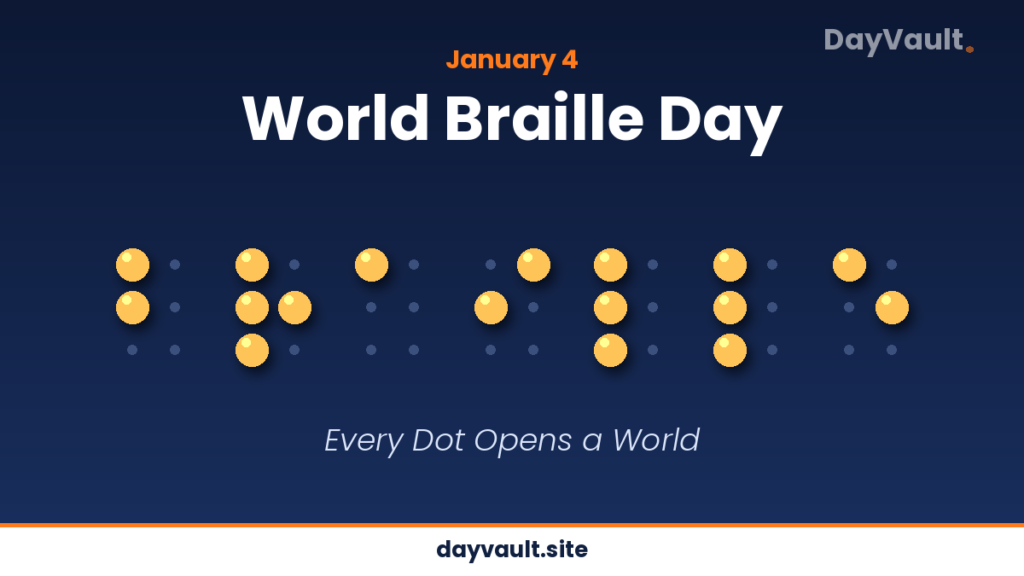
Introduction
Imagine opening a book, reading a medicine label, checking an elevator button, or studying for an important examination. For many people, these everyday activities depend on printed words and visual information. For people who are blind or have visual impairments, Braille can make many of these experiences accessible through touch.
World Braille Day is observed every year on January 4 to recognize the importance of Braille as a means of communication and to promote the rights, independence, and inclusion of people who are blind or partially sighted. The date also marks the birthday of Louis Braille, the French educator who developed the Braille reading and writing system.
Established by the United Nations General Assembly in 2018, the observance was first celebrated internationally in 2019. It reminds governments, educational institutions, businesses, and communities that access to information is essential for equality and participation in society.
World Braille Day is more than a celebration of an important invention. It is an opportunity to understand how accessible communication improves lives, why inclusive education matters, and what everyone can do to help create a world where information is available to all.
What Is World Braille Day?
World Braille Day is an international observance dedicated to raising awareness about Braille and its role in making written communication accessible to people with visual impairments.
Braille is a tactile writing system that allows readers to recognize letters, numbers, punctuation marks, and other symbols by touching patterns of raised dots. It enables people who use it to read books, study academic subjects, write notes, access information, and participate more independently in everyday activities.
The United Nations recognizes Braille as an important tool for realizing human rights, particularly the rights to education, freedom of expression, access to information, and social inclusion.
World Braille Day encourages people to recognize that accessibility is not simply a convenience. It is an important part of creating equal opportunities.
The observance also highlights the continuing need for accessible public services, educational resources, digital platforms, and printed information. Although technology has created new ways to access information, Braille remains valuable for literacy and independent reading.
When Is World Braille Day Celebrated?
World Braille Day is celebrated annually on January 4.
The date was selected because it is the birthday of Louis Braille, who was born on January 4, 1809, in Coupvray, France.
The United Nations General Assembly officially proclaimed January 4 as World Braille Day through Resolution A/RES/73/161 in December 2018. The first official observance took place on January 4, 2019.
Here are the key details:
- Date: January 4 every year
- First official observance: January 4, 2019
- Established by: United Nations General Assembly
- Purpose: To raise awareness about Braille, accessible communication, and the rights of people who are blind or partially sighted
- Who can participate: Individuals, schools, universities, libraries, organizations, governments, and communities worldwide
Because World Braille Day occurs at the beginning of January, it is also a useful opportunity to start the year by learning about accessibility and finding practical ways to make communities more inclusive.
Who Was Louis Braille?

Louis Braille was a French educator and the inventor of the Braille system. His work transformed the way people who are blind could read and write.
He was born in 1809 in Coupvray, a village near Paris. As a young child, he suffered an eye injury while playing in his father’s workshop. An infection developed, and he eventually lost his sight.
Despite this challenge, Louis continued his education and later attended the Royal Institute for Blind Youth in Paris. At the time, educational opportunities for blind students were limited, and conventional reading methods were often slow and difficult to use.
Louis wanted to develop a more practical system that would allow blind people to read and write efficiently.
How Did Louis Braille Develop the System?
During his time at school, Louis learned about a tactile communication method developed by Charles Barbier, a French army officer. Barbier’s system used raised dots to represent sounds and was intended to help soldiers communicate silently in darkness.
Louis recognized the potential of raised dots but understood that the system needed improvements to become more practical for everyday reading and writing.
As a teenager, he worked on a simpler method based on a cell of six raised dots. Different combinations of these dots could represent letters and other symbols.
He developed his system in 1824, when he was just 15 years old. Over time, it became a powerful tool for literacy, education, and independent communication.
Although acceptance of the system took time, Braille’s invention eventually became widely used around the world. His contribution continues to influence education, publishing, and accessibility today.
World Braille Day honors his achievement while recognizing the countless people who have helped expand access to Braille throughout history.
How Does the Braille System Work?
Braille works through patterns of raised dots arranged in small rectangular cells. Readers move their fingertips over the dots to identify different letters, numbers, and symbols.
The traditional Braille cell contains six positions arranged in two columns of three dots each. By combining raised dots in different patterns, the system represents a wide range of information.
The Braille Alphabet
Each letter of the alphabet has a corresponding Braille pattern. For example, the letters A through J use different combinations of the upper four positions in a standard six-dot cell.
Additional patterns represent the remaining letters, punctuation, numbers, and other symbols.
Numbers are commonly indicated using a numerical indicator followed by patterns corresponding to letters A through J, depending on the Braille code being used.
Braille can also represent:
- Mathematical equations and scientific notation
- Musical notes and musical instructions
- Punctuation and formatting
- Abbreviations and contractions
- Symbols used in different languages
Specialized Braille codes allow readers to study subjects such as mathematics, science, and music.
How Is Braille Written?
Braille can be produced in several ways, including:
- Slate and stylus: A simple tool used to create Braille dots on paper.
- Braillewriter: A mechanical or electronic device with keys corresponding to the dot positions.
- Refreshable Braille display: An electronic device that raises and lowers small pins to present changing Braille characters.
- Braille embossing printer: A printer designed to produce raised dots on paper.
These methods make it possible to create everything from handwritten notes to textbooks and digital documents.
Braille is not a separate language. It is a system for representing written language, and different Braille codes support different languages and purposes.
Why Is World Braille Day Important?
World Braille Day matters because access to written information affects education, employment, independence, and participation in society.
For people who use Braille, the ability to read and write can open doors to opportunities that might otherwise be difficult to access.
1. It Promotes Equal Access to Education
Education should be available to every learner, regardless of visual ability.
Braille textbooks, worksheets, examination papers, and learning materials allow students who use Braille to study subjects and develop literacy skills.
When educational institutions provide accessible materials, students can participate more fully in classroom activities and work toward their academic goals.
World Braille Day encourages schools and governments to invest in inclusive learning environments rather than expecting students to overcome avoidable barriers on their own.
2. It Supports Independence
Reading information independently can help people make everyday decisions with greater confidence.
Braille may be used to identify household products, organize personal belongings, read notes, label files, or navigate buildings.
Access to written information can also support privacy. For example, a person who reads Braille may be able to read a personal document without relying entirely on someone else to read it aloud.
The value of Braille extends beyond convenience. It can strengthen autonomy and personal choice.
3. It Improves Access to Information
Important information should be available in formats that people can use.
Consider public safety instructions, medical information, educational materials, and government documents. When such information is provided only in inaccessible formats, people who are blind or partially sighted may face unnecessary barriers.
Providing Braille alongside other accessible formats helps more people obtain information directly.
4. It Encourages Social Inclusion
Accessibility helps people participate in their communities.
When schools, workplaces, libraries, hospitals, and public buildings consider the needs of people with visual impairments, they create environments where more people can participate comfortably.
World Braille Day also challenges assumptions about blindness. People who are blind or partially sighted have diverse abilities, interests, and ambitions. Accessible information helps them pursue those ambitions on more equal terms.
5. It Raises Awareness About Accessibility
Many people have heard of Braille without understanding how it works or why it remains relevant.
World Braille Day provides an opportunity to introduce the system to students, families, educators, and employers.
Greater awareness can lead to practical changes, such as providing accessible classroom materials, improving public signage, and ensuring that digital information works with assistive technologies.
The Role of Braille in Modern Technology

Technology has changed how people access written information, but Braille continues to play an important role.
Screen readers convert digital text into speech, allowing users to listen to emails, websites, documents, and other content. Refreshable Braille displays offer another option by converting digital text into tactile characters.
These technologies can work together, giving users flexibility in how they read and interact with information.
Refreshable Braille Displays
A refreshable Braille display connects to a computer, smartphone, or other compatible device. Small pins rise and fall to represent a line of text in Braille.
As the user moves through a document, the displayed characters change.
This technology allows readers to access digital content tactilely, including information that changes frequently.
Accessible Websites and Applications
Digital accessibility is another important part of inclusion.
Websites and applications should be designed so that people who use screen readers, keyboards, and Braille displays can navigate them effectively.
Useful accessibility practices include:
- Providing meaningful alternative text for informative images.
- Using clear headings and logical page structures.
- Giving form fields descriptive labels.
- Making interactive elements usable with a keyboard.
- Using descriptive link text.
- Avoiding images of text when accessible text can be provided instead.
These improvements benefit many users, not only people who are blind.
Why Braille Still Matters
Audio technology is valuable, but listening and reading are different experiences.
Braille gives readers direct access to spelling, punctuation, formatting, and written structure. It can be especially important for learning literacy, studying technical subjects, and understanding how written language works.
Not every person with a visual impairment uses Braille, and individual preferences vary. Accessible communication should therefore offer appropriate choices, including Braille, audio, large print, and digital formats where possible.
How to Celebrate World Braille Day
You do not need to organize a large event to participate in World Braille Day. Small educational activities can help spread awareness and encourage practical improvements.
Here are several meaningful ways to observe the day.
1. Learn the Basics of Braille
Spend a few minutes exploring the Braille alphabet and learning how raised dots represent letters and symbols.
Understanding the basic system can help you appreciate the skill involved in reading and writing through touch.
You can also explore educational resources from organizations that support people who are blind or partially sighted.
2. Organize a School Awareness Activity
Teachers can introduce students to the history of Louis Braille and explain why accessible learning materials matter.
Possible activities include:
- Creating an educational poster about World Braille Day.
- Demonstrating how a Braille cell is arranged.
- Discussing inclusive education.
- Exploring accessible books and reading tools.
- Inviting a Braille reader or accessibility educator to share their experience, where appropriate.
The goal should be to promote understanding and respect rather than treating blindness as something to be pitied.
3. Share Educational Information Online
Social media can help introduce World Braille Day to a wider audience.
You can publish a short article, an accessible infographic, or a post explaining the history and importance of Braille.
Use descriptive captions and meaningful alternative text for images. If your post includes a video, consider adding captions and an audio description when relevant.
4. Support Accessible Libraries
Libraries play an important role in helping people access books and educational resources.
On World Braille Day, consider learning whether local libraries offer Braille books, accessible digital collections, audiobooks, or services for readers with visual impairments.
You can also encourage libraries to improve their accessible collections and provide information in multiple formats.
5. Make Your Website More Accessible
Website owners, bloggers, and businesses can use the observance as a reminder to review their digital accessibility.
Check whether your website has meaningful image descriptions, readable content structures, accessible forms, and clear navigation.
For a website such as DayVault, publishing accurate educational content about international observances is one way to increase awareness. Making that content accessible is an equally important step.
6. Listen to People Who Use Braille
Personal experiences can offer valuable insights into how accessibility affects everyday life.
Read articles, interviews, and educational materials created by people who are blind or partially sighted. Learn about the barriers they identify and the solutions they recommend.
The most effective inclusion efforts involve listening to people directly affected by accessibility decisions.
Challenges in Braille Literacy and Accessibility
Despite significant progress, access to Braille and accessible information remains uneven.
Limited Access to Learning Materials
Braille books can require specialized production equipment and materials. In some communities, students may have limited access to suitable textbooks, trained instructors, or learning devices.
When materials are unavailable or arrive late, students can face disadvantages compared with their classmates.
Governments, schools, publishers, and nonprofit organizations can help by investing in accessible educational resources and supporting Braille instruction.
Financial Barriers
Some Braille devices and specialized technologies can be expensive.
The cost of equipment may make it difficult for individuals, families, and educational institutions to obtain the tools they need.
Accessible public services, financial support programs, libraries, and technology initiatives can help reduce these barriers.
Insufficient Public Awareness
Many organizations may overlook Braille when designing public spaces, educational programs, or communication materials.
Greater awareness can encourage decision-makers to consider accessibility from the beginning rather than treating it as an afterthought.
The Need for Inclusive Digital Design
Digital services are increasingly used for education, employment, banking, shopping, and communication.
If websites and applications are poorly designed, users of assistive technologies may be unable to access important features.
Accessibility should therefore be considered throughout the design and development process.
Addressing these challenges requires sustained action. One annual observance can raise awareness, but lasting progress depends on everyday decisions, inclusive policies, and meaningful participation by people with disabilities.
World Braille Day and the Future of Inclusion
The future of Braille is closely connected to broader efforts to make education, information, and technology accessible.
New assistive technologies may make digital reading more flexible, while accessible publishing can help readers obtain materials in formats suited to their needs.
However, innovation alone is not enough. Technology must be affordable, available, and designed with the people who use it in mind.
Schools need appropriate teaching resources. Employers need inclusive workplace practices. Public institutions need accessible communication. Website owners need to consider how visitors with different access needs interact with their content.
World Braille Day reminds us that inclusion is not achieved simply by acknowledging differences. It requires removing barriers that prevent people from participating fully.
The principles behind the observance are relevant to every community: respect individual choice, provide accessible information, listen to people’s experiences, and make equal participation a practical priority.
Frequently Asked Questions About World Braille Day
1. When is World Braille Day celebrated?
World Braille Day is celebrated every year on January 4. The date marks the birthday of Louis Braille, the French educator who developed the Braille reading and writing system. The United Nations officially established the observance in 2018, and the first World Braille Day took place in 2019.
2. Why do we celebrate World Braille Day?
World Braille Day raises awareness of the importance of Braille for literacy, education, independence, and access to information. It also promotes the rights and inclusion of people who are blind or partially sighted and encourages organizations to make communication more accessible.
3. Who invented the Braille system?
Louis Braille, a French educator born in 1809, developed the Braille system. After losing his sight as a young child, he worked on a tactile reading and writing method that used combinations of raised dots. He developed the system in 1824 when he was 15 years old.
4. How does Braille help people who are blind?
Braille allows readers to recognize letters, numbers, punctuation, and other symbols through touch. It supports independent reading and writing, literacy development, education, and access to information. It can also help people identify labels, read documents, and use compatible digital devices.
5. How can I celebrate World Braille Day?
You can celebrate World Braille Day by learning about Braille, sharing accurate information, organizing school awareness activities, supporting accessible libraries, and improving the accessibility of websites and public information. Listening to people who are blind or partially sighted is also an important way to understand their experiences and accessibility needs.
Conclusion
World Braille Day, observed on January 4, celebrates the lasting contribution of Louis Braille and highlights the importance of accessible communication for people who are blind or partially sighted.
Braille is much more than a pattern of raised dots. It is a valuable literacy system that supports education, independence, personal choice, and participation in society. Although modern technology has expanded the ways people access information, Braille continues to play an important role in reading and learning.
The observance also reminds us that accessibility requires more than good intentions. Schools must provide appropriate learning materials, businesses must consider inclusive communication, and digital platforms must work with assistive technologies.
Everyone can contribute by learning about Braille, sharing reliable information, supporting accessibility initiatives, and listening to the people who use these resources.
As World Braille Day approaches each year, let it serve as a reminder that information should not be limited by the way a person sees. A more inclusive world begins when everyone has a fair opportunity to learn, communicate, and participate independently.
For DayVault readers, World Braille Day is an opportunity to recognize an important international observance and take a meaningful step toward greater awareness, accessibility, and inclusion.
Q1. When is World Braille Day celebrated?
World Braille Day is celebrated every year on January 4 to raise awareness about Braille and its importance for people who are blind or partially sighted.
Q2. Why is World Braille Day celebrated on January 4?
January 4 is the birthday of Louis Braille, the French educator who developed the Braille reading and writing system.
Q3. Who invented Braille?
Louis Braille invented the Braille system in 1824 when he was 15 years old. His invention transformed access to reading and writing for people who are blind.
Q4. What is the purpose of World Braille Day?
The purpose of World Braille Day is to promote Braille literacy, accessible communication, inclusive education, and equal opportunities for people with visual impairments.
Q5. How does Braille work?
Braille uses patterns of raised dots arranged in cells. Readers use their fingertips to identify letters, numbers, punctuation marks, and other symbols.
Q6. Is Braille a language?
No, Braille is a tactile writing system, not a language. It represents written languages through patterns of raised dots.
Q7. Who established World Braille Day?
The United Nations General Assembly officially established World Braille Day in 2018. The first official observance took place on January 4, 2019.
Q8. How can schools celebrate World Braille Day?
Schools can celebrate by teaching students about Braille, organizing awareness activities, exploring accessible books, and discussing the importance of inclusive education.
Q9. Is Braille still important in the digital age?
Yes. Braille remains important for literacy, spelling, independent reading, and education. Modern devices, including refreshable Braille displays, also allow users to access digital information through touch.
Q10. How can people support World Braille Day?
People can support World Braille Day by sharing educational information, promoting accessible websites and learning materials, supporting Braille literacy programs, and advocating for equal access to information.
