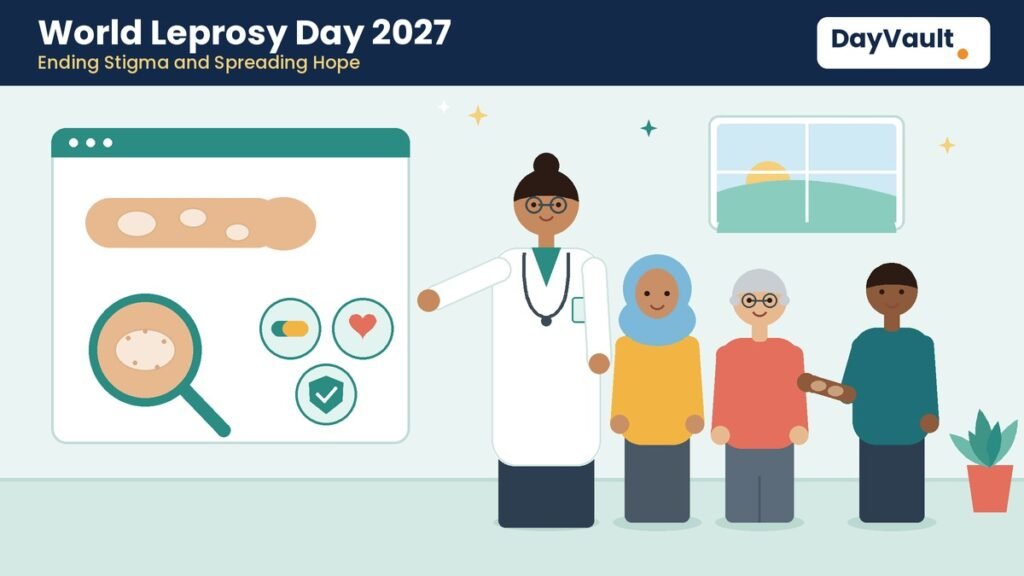
Few diseases carry as much fear as leprosy, and few are as misunderstood. World Leprosy Day: Ending Stigma and Spreading Hope is the annual reminder that leprosy can be cured, that people who have had it deserve respect, and that ignorance is still one of the biggest barriers to care.
This guide covers the date, the history, the medical facts, the myths worth retiring, and simple ways to take part.
When Is World Leprosy Day?
The observance falls on the last Sunday of January every year, so the calendar date shifts:
- 2027: Sunday, 31 January
- 2028: Sunday, 30 January
- 2029: Sunday, 28 January
India marks the day on 30 January instead. That is the anniversary of Mahatma Gandhi’s death, which links the date to his well known compassion for people living with leprosy.
What Is World Leprosy Day?
World Leprosy Day is an international awareness day. It is backed by the World Health Organization, national health programmes and many charities, but it is not a United Nations international day. It is best described as a long running public health observance with one clear purpose: to replace fear with facts.
On this day you will typically see:
- Health talks and free skin screening camps
- Stories shared by people who have been through leprosy and treatment
- Calls to end discriminatory laws and practices
- Fundraising for early detection, treatment and rehabilitation
What Is Leprosy, Also Known as Hansen’s Disease?
Leprosy is a long lasting bacterial infection caused by Mycobacterium leprae. It mainly attacks the skin and the peripheral nerves, which carry signals between the brain and the limbs. The alternative name, Hansen’s disease, honours the Norwegian doctor who identified the bacterium in the nineteenth century.
Early warning signs include:
- Light or reddish patches on the skin
- Patches that feel numb or less sensitive to touch
- Tingling, weakness or numbness in hands and feet
- Small wounds or burns that cause no pain
The disease spreads far less easily than most people assume. It passes through tiny droplets from the nose and mouth, and usually only after long, close contact with someone who has not been treated. Everyday contact such as shaking hands, sharing food or sitting beside someone does not spread it, and most people have natural resistance.
The lasting disability linked with leprosy is not a certain outcome. It develops when nerve damage goes unnoticed. A person who cannot feel pain may keep injuring a hand or foot without realising it. Catching the disease early prevents most of this harm.
History and Origin of World Leprosy Day
References to leprosy appear in the records of many ancient cultures. For centuries, those diagnosed were frequently forced out of their villages and cities. That habit of exclusion outlived the era in which it started, and its effects are still felt today.
The awareness day began in 1954, started by Raoul Follereau, a French writer and humanitarian. He picked the last Sunday of January partly to honour Gandhi. His central idea was that people with leprosy needed dignity and inclusion, not charity delivered from a distance.
Medicine has moved a long way since then. From the early 1980s, a combination of antibiotics became the standard treatment, and it changed the outlook completely. Registered cases dropped from millions in the mid 1980s to a few hundred thousand today.
Why Is World Leprosy Day Important?
If a cure exists, why keep holding the day? Three reasons matter most.
Fear delays diagnosis. Many people with early symptoms stay silent because they dread being rejected by family or employers. Waiting is exactly what allows permanent damage to develop.
Discrimination remains. In 2024, several countries still reported laws that treat people affected by leprosy unfairly, with dozens of such provisions in force.
Transmission continues. New cases are found every year, including among children. Reaching zero means finding cases sooner and protecting the contacts of patients.
Leprosy Around the World: Facts and Figures
Global reporting for 2024 shows steady progress alongside real challenges:
- About 172,700 new cases were reported worldwide.
- Out of 188 countries and territories that supplied data, 55 recorded no new cases at all.
- A group of 23 priority countries accounted for roughly 96% of new cases.
- South East Asia contributed close to three quarters of the global total.
- India, Brazil and Indonesia each reported more than 10,000 new cases.
- Around 9,400 of the new cases were in children under 15.
- About 1.7 million people were given a single preventive antibiotic dose as a protective measure after contact with a patient.
There is encouraging news too. In September 2024, Jordan became the first country officially verified as having eliminated leprosy. Making the disease notifiable, so that every case is reported, was a major factor. India has since aimed to eliminate leprosy by 2027 and made the disease notifiable in 2025, though transmission continues in some remote and tribal areas.
Myths and Facts About Leprosy
Myth: Leprosy spreads easily.
Fact: It is difficult to catch, and treated patients quickly stop being a source of infection.
Myth: Leprosy makes fingers and toes drop off.
Fact: Tissue loss comes from repeated, unnoticed injuries to numb skin, not from the bacteria consuming the body.
Myth: It is a punishment or a curse.
Fact: It is an ordinary infection that responds to antibiotics.
Myth: It disappeared long ago.
Fact: Thousands of people are diagnosed each year, mainly across parts of Asia, Africa and Latin America.
Treatment: Leprosy Is Curable
The standard treatment combines three antibiotics (dapsone, rifampicin and clofazimine) taken together. Milder forms are cured in about six months, and more advanced forms in about twelve. The medicines are supplied to national programmes at no cost, so price should never be a reason to delay seeking care.
Cure does not always remove every effect. Some people live with lasting nerve damage or visible changes and benefit from ongoing support, such as self care training, protective footwear, rehabilitation and sometimes surgery. Emotional wellbeing matters as well. Years of being avoided or judged can leave deep marks, which is why recent campaigns pair medical care with mental health support.
Themes and Campaign Messages
Each year the day carries a slogan, but the underlying message stays consistent. The 2026 message stressed that the disease can be cured while the real obstacle is stigma. Earlier years focused on dignity, ending discrimination and mental wellbeing. The theme for 2027 had not been announced when this article was written, so check with leading health bodies as the date approaches.
How to Take Part in World Leprosy Day
You do not need a medical background to make a difference:
- Learn the basics. Understanding how leprosy spreads and how it is treated is the best first step.
- Share accurate facts. Pass on trustworthy information and gently correct myths when you hear them.
- Use respectful words. Say “a person affected by leprosy” and avoid the outdated, hurtful label.
- Support trusted organisations. Donate or volunteer with groups that have a clear record, and check how they use money.
- Act on symptoms. A numb patch or a skin mark that does not heal should be seen by a doctor.
- Talk in your community. Schools, workplaces and local groups can host short, friendly awareness sessions.
- Include people. Welcoming people who have had leprosy into jobs and social life makes the biggest difference.
Related Days and Topics
This observance connects naturally to World Neglected Tropical Diseases Day on 30 January, the International Day of Persons with Disabilities on 3 December, World Health Day on 7 April and World Mental Health Day on 10 October.
Frequently Asked Questions
When is World Leprosy Day 2027?
It falls on Sunday, 31 January 2027, the last Sunday of the month.
Who started World Leprosy Day?
The French humanitarian Raoul Follereau launched it in 1954.
Why is the date at the end of January?
It was chosen to honour Mahatma Gandhi, who died on 30 January 1948 and is remembered for caring about people with leprosy.
Is it an official United Nations day?
No. It is a widely observed awareness day supported by health bodies and charities.
Can leprosy be cured?
Yes. A course of combined antibiotics cures it, and early treatment prevents disability.
Does leprosy still exist?
Yes. Roughly 172,700 new cases were reported worldwide in 2024.
Is leprosy contagious through touch?
No. It needs prolonged close contact with an untreated person, and casual touch does not spread it.
Conclusion
Leprosy is a disease we know how to cure, and one that can be stopped with enough early detection and public understanding. The harder work is changing attitudes. On World Leprosy Day, sharing one accurate fact or choosing one respectful word is a small step that helps build a world where nobody hides from treatment out of fear
