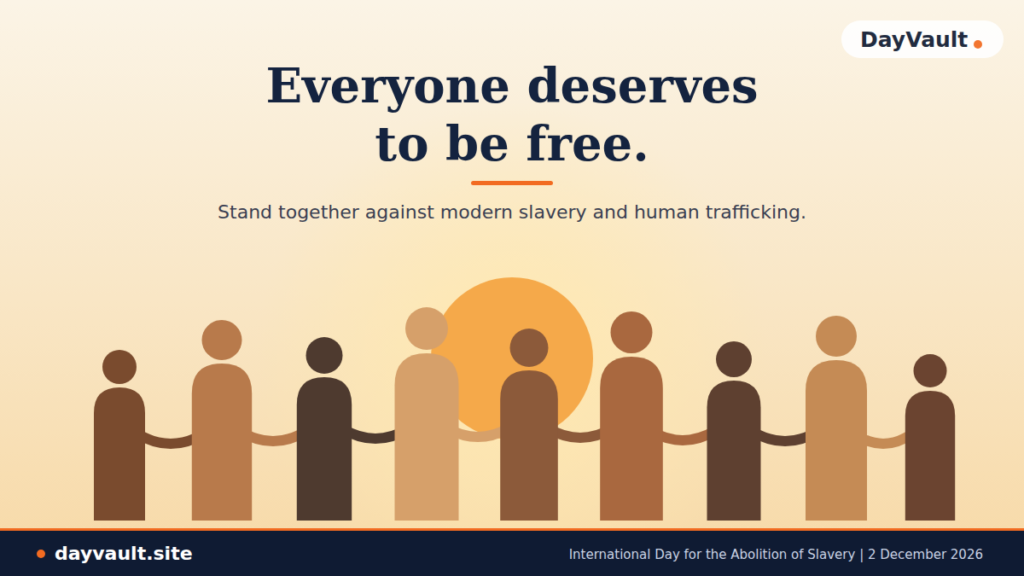
Freedom is one of the most fundamental human rights, yet millions of people around the world continue to experience exploitation, coercion, and situations in which they cannot freely choose their work or personal lives. Although slavery is often associated with historical events, its modern forms remain a serious global concern.
The International Day for the Abolition of Slavery, observed every year on December 2, raises awareness about slavery, human trafficking, forced labour, and other forms of exploitation. It encourages governments, communities, organizations, and individuals to work together to protect human dignity and ensure that every person can live with freedom and equality.
This international observance is not simply about remembering the past. It is also about recognizing the challenges that remain today and understanding how people can contribute to a world free from exploitation.
In this article, we explore the history, purpose, significance, and modern relevance of the International Day for the Abolition of Slavery, along with practical ways to support the fight against modern slavery.
What Is the International Day for the Abolition of Slavery?
The International Day for the Abolition of Slavery is a United Nations observance dedicated to raising awareness about slavery and practices that deprive people of their freedom, dignity, and basic human rights.
It is observed annually on December 2. The day highlights the importance of eliminating contemporary forms of slavery, including human trafficking, forced labour, debt bondage, sexual exploitation, and forced marriage.
According to the United Nations, the observance focuses on the eradication of contemporary forms of slavery rather than solely commemorating historical abolition movements.
The day reminds the international community that legal prohibitions alone are not enough. Effective action also requires education, economic opportunities, stronger protections for vulnerable people, and accountability for those responsible for exploitation.
The International Day for the Abolition of Slavery also encourages people to recognize that freedom is not merely the absence of physical restraint. It includes the ability to make personal choices, access education, work under fair conditions, and live without threats or coercion.
When Is the International Day for the Abolition of Slavery Celebrated?
The International Day for the Abolition of Slavery is celebrated every year on December 2.
The United Nations General Assembly established this observance in 1986, building on its earlier work against slavery and the slave trade. The date is connected to the adoption of the United Nations Convention for the Suppression of the Traffic in Persons and of the Exploitation of the Prostitution of Others on December 2, 1949.
The day provides an opportunity for international organizations, educational institutions, governments, and civil society groups to discuss the causes and consequences of slavery.
Common activities associated with the observance include:
- Educational seminars about human rights and modern slavery.
- Awareness campaigns on human trafficking and forced labour.
- School and university discussions about equality and freedom.
- Community events promoting safe working conditions.
- Social media campaigns sharing reliable information.
- Advocacy for stronger laws and better protection for survivors.
For individuals, the day can be an opportunity to learn about exploitation, support credible human rights initiatives, and encourage conversations about dignity and justice.
Readers can find additional information about the date and its purpose on the United Nations’ official observance page.
History of the Abolition of Slavery
Slavery has existed in different societies throughout history. People have been enslaved through warfare, conquest, kidnapping, inherited status, debt, and other forms of coercion.
The transatlantic slave trade was one of the most devastating examples. Millions of Africans were forcibly transported across the Atlantic and subjected to brutal conditions, forced labour, family separation, and systematic denial of their rights.
Enslaved people resisted in many ways, from preserving cultural traditions and escaping captivity to organizing rebellions and supporting abolitionist movements. Their resistance was central to the long struggle against slavery.
Activists, writers, religious communities, formerly enslaved people, and political reformers also challenged the institution, helping build movements that demanded legal and social change.
The Growth of Abolition Movements
Abolition movements developed across different countries and historical periods. Their efforts contributed to laws restricting and abolishing slavery, although legal changes often faced resistance and did not immediately eliminate exploitation.
In the nineteenth century, several countries introduced laws ending slavery or the legal slave trade within their jurisdictions. However, the consequences of slavery continued through discrimination, unequal access to education, economic exclusion, and other forms of injustice.
International cooperation became increasingly important during the twentieth century.
The Universal Declaration of Human Rights, adopted in 1948, established a fundamental principle in Article 4: no one should be held in slavery or servitude, and slavery and the slave trade should be prohibited in all their forms.
Later international agreements strengthened protections against slavery, forced labour, trafficking, and related practices.
The International Day for the Abolition of Slavery reflects this continuing international commitment. It recognizes the achievements of abolition movements while emphasizing that the work of protecting freedom is not finished.
Why Is the International Day for the Abolition of Slavery Important?
The International Day for the Abolition of Slavery matters because exploitation continues to affect people in different countries, industries, and communities.
Although slavery is prohibited under international law, people can still become trapped in situations involving threats, deception, abuse of power, or restrictions on their freedom.
The observance helps bring attention to several important issues.
1. Raising Awareness About Modern Slavery
Many people associate slavery with historical plantations, chains, and slave markets. However, contemporary exploitation can be much less visible.
A person may work in a factory, on a farm, in a private household, or at a construction site while facing threats, withheld wages, or restrictions on leaving the job.
Public awareness helps people understand that slavery is not only a historical issue. It can occur within modern economies and supply chains.
2. Protecting Human Rights
Every person deserves freedom, safety, and equal treatment under the law.
Slavery violates these fundamental rights by treating human beings as instruments for someone else’s benefit. Victims may lose control over their work, movement, finances, relationships, or personal decisions.
Recognizing these violations is an important step toward building societies in which everyone can live with dignity.
3. Supporting Vulnerable Communities
Poverty, discrimination, displacement, limited access to education, and a lack of secure employment can increase vulnerability to exploitation.
People facing these circumstances may be more susceptible to fraudulent job offers, recruitment fees, deceptive migration arrangements, or promises of financial security.
Awareness campaigns can help communities identify risks and understand where to seek reliable assistance.
4. Encouraging Government and Business Action
Governments have responsibilities to prevent exploitation, investigate crimes, protect victims, and enforce relevant laws.
Businesses also have an important role. Employers and supply-chain operators should take reasonable steps to identify forced labour risks, provide safe working conditions, and address abuses connected with their operations.
The observance reinforces the idea that ending slavery requires cooperation among governments, businesses, workers, communities, and international institutions.
What Is Modern Slavery?
Modern slavery is a broad term used to describe situations involving severe exploitation in which people cannot refuse or leave because of threats, coercion, deception, or abuse of power.
It is not one single legal category. Instead, it describes several practices that violate human freedom and dignity.
The International Labour Organization, Walk Free, and the International Organization for Migration estimated that 50 million people were living in situations of modern slavery on any given day in 2021. Their 2022 global estimates identified approximately 28 million people in forced labour and 22 million in forced marriage.
These figures describe the findings of that particular study, rather than a real-time count of people experiencing exploitation today.
Modern slavery can take several forms.
Forced Labour
Forced labour occurs when people are made to work against their will under the threat of a penalty or other coercive circumstances.
Examples can include workers being threatened with violence, having identity documents confiscated, being prevented from leaving, or being forced to continue working to avoid punishment.
Forced labour can occur in agriculture, construction, manufacturing, domestic work, and other sectors.
Human Trafficking
Human trafficking involves the recruitment, transportation, transfer, harbouring, or receipt of people for exploitation through means defined by applicable law.
Traffickers may use deception, threats, force, or abuse of vulnerability to exploit victims.
Trafficking does not always involve crossing an international border. It can occur within a person’s own country.
Debt Bondage
Debt bondage occurs when someone is trapped in labour or services connected to a debt under exploitative conditions.
A worker may be charged excessive recruitment fees, face manipulated accounts, or discover that deductions make repayment practically impossible.
In these circumstances, the supposed debt can become a means of controlling the worker.
Forced Marriage
Forced marriage occurs when a person does not freely and fully consent to the marriage.
Pressure, threats, violence, or abuse of authority can deprive someone of meaningful choice. Forced marriage can have lasting consequences for education, personal freedom, safety, and economic independence.
Other Forms of Exploitation
Contemporary slavery-related abuses can also include certain forms of servitude, exploitation of children, and sexual exploitation.
Child labour and modern slavery are related but not identical concepts. Not every instance of child labour meets the definition of forced labour or slavery, although the most harmful forms of child labour can overlap with these abuses.
Understanding these distinctions helps people recognize exploitation without treating every difficult or unfair working condition as legally equivalent to slavery.
The Global Impact of Modern Slavery
Modern slavery affects individuals, families, communities, businesses, and national economies.
Its consequences extend far beyond the immediate loss of freedom.
Physical and Emotional Harm
People experiencing exploitation may face violence, dangerous working environments, inadequate food, restricted movement, and separation from their families.
Survivors may also experience lasting emotional distress, fear, and difficulties rebuilding their lives after escaping an exploitative situation.
Access to safe accommodation, healthcare, legal support, and long-term assistance can be essential to recovery.
Economic Inequality
Forced labour allows exploiters to benefit from work without providing fair compensation or respecting workers’ rights.
This can undermine legitimate businesses, weaken labour protections, and deepen economic inequality.
The International Labour Organization’s 2024 report, Profits and Poverty: The Economics of Forced Labour, estimated that illegal profits from forced labour amount to US$236 billion annually. This figure reflects the report’s estimate and methodology, not a direct measurement of every form of modern slavery.
Harm to Children and Families
Children affected by exploitation may lose opportunities for education, safety, and healthy development.
When adults are exploited, entire families can suffer through lost income, separation, and insecurity. Children may also face increased risks when their families lack access to stable housing, schooling, and social protection.
Preventing exploitation therefore requires more than rescuing individuals. It also requires addressing the conditions that allow abuse to continue.
How Can We Help End Modern Slavery?
The fight against modern slavery requires coordinated action, but individuals and communities can still make meaningful contributions.
1. Learn and Share Reliable Information
Education helps people recognize exploitation and understand their rights.
Use trustworthy resources from organizations such as the United Nations and International Labour Organization. Share accurate information through community discussions, educational activities, and responsible social media posts.
Avoid spreading unverified statistics or sensational stories that undermine public understanding.
2. Support Ethical Businesses
Consumers can learn about how products are made and whether businesses have credible policies addressing labour exploitation.
Useful steps include:
- Looking for transparent information about sourcing and working conditions.
- Supporting businesses that respect workers’ rights.
- Paying attention to credible reporting about labour abuses.
- Encouraging companies to address risks within their supply chains.
No single purchase can guarantee that a product is free from exploitation, but informed decisions can contribute to broader demands for accountability.
3. Promote Education and Fair Employment
Access to education, decent work, social protection, and reliable information about employment opportunities can help reduce vulnerability.
Schools, community organizations, and employers can provide information about workers’ rights, safe recruitment, and the warning signs of fraudulent job offers.
Young people and migrant workers can particularly benefit from accessible information about employment contracts, recruitment fees, and available support services.
4. Support Credible Organizations
People can support established organizations working to prevent trafficking, assist survivors, improve labour protections, and promote human rights.
Contributions may include donations, volunteering, awareness campaigns, or participation in educational programmes.
Before donating or volunteering, check an organization’s credibility, safeguarding practices, and the way it explains its work.
5. Report Suspected Exploitation Safely
If you suspect that someone is being exploited, seek guidance from appropriate local authorities or a reputable anti-trafficking organization.
Do not confront suspected traffickers or put yourself or the potentially affected person at risk.
If someone appears to be in immediate danger, contact the appropriate emergency services where available.
Respect the privacy and dignity of potential victims. Avoid sharing their names, photographs, or personal circumstances publicly without appropriate consent.
6. Encourage Stronger Protections
Citizens can encourage public institutions to strengthen labour protections, investigate exploitation, protect whistleblowers, and provide support to survivors.
Businesses can establish responsible recruitment practices, improve supply-chain transparency, and respond appropriately when abuse is identified.
Lasting progress depends on prevention, effective enforcement, and support that enables survivors to rebuild their lives.
How Is the International Day for the Abolition of Slavery Observed?
The day is marked through educational, public awareness, and advocacy activities around the world.
Although activities differ by country and organization, their common purpose is to increase understanding and encourage action.
Educational Activities
Schools, colleges, and universities can organize presentations, classroom discussions, reading activities, and research projects.
Students can explore the history of slavery, the development of human rights law, and the challenges involved in preventing modern exploitation.
These activities help younger generations understand the importance of freedom and equality.
Awareness Campaigns
Human rights organizations may use websites, newsletters, social media, and public events to explain the causes and consequences of slavery.
Campaigns can share verified information, promote safe recruitment practices, and highlight available support services.
Community Discussions
Community groups can organize talks about workers’ rights, human trafficking prevention, and access to education.
Such discussions are particularly useful when they connect general awareness with practical information about local protections and reporting options.
Advocacy and Public Engagement
Organizations may call for better enforcement of anti-trafficking laws, stronger workplace protections, and improved support for survivors.
The observance also offers an opportunity to review existing efforts and identify where additional action is needed.
The Role of Young People in Ending Slavery
Young people can contribute to the fight against modern slavery through education, responsible communication, and community involvement.
Students and young professionals can use their skills to help spread awareness and challenge harmful attitudes.
For example, they can:
- Create educational posters and presentations.
- Share reliable information about human rights.
- Participate in school and community awareness events.
- Learn about safe employment and recruitment practices.
- Volunteer with reputable organizations.
- Encourage respectful treatment and equality in their communities.
Digital platforms can make awareness campaigns more accessible, but accuracy matters. Young people should verify information before sharing it and avoid content that exposes survivors to unwanted attention.
By developing informed attitudes and supporting fair treatment, the next generation can help create communities in which exploitation is less likely to be ignored or accepted.
Why Freedom and Human Dignity Matter Today
Freedom is essential to human development. People should be able to choose their work, pursue education, maintain family relationships, and make decisions about their lives without coercion.
The abolition of slavery is therefore connected to wider goals such as reducing poverty, improving education, promoting gender equality, and ensuring decent work.
Legal protections remain essential, but they must be supported by practical opportunities. People need access to safe employment, fair wages, effective justice systems, and support when they experience abuse.
It is also important to recognize the voices and experiences of survivors. They should be treated with dignity, included in decisions affecting their lives, and given opportunities to participate in recovery and prevention efforts.
The International Day for the Abolition of Slavery reminds us that human rights are meaningful only when they are protected in everyday life.
Ending modern slavery is a long-term responsibility that requires sustained effort, international cooperation, and a commitment to treating every person as a human being with inherent worth.
Frequently Asked Questions
1. When is the International Day for the Abolition of Slavery celebrated?
The International Day for the Abolition of Slavery is observed every year on December 2. The United Nations established the observance in 1986 to promote awareness and action against contemporary forms of slavery.
2. Why is the International Day for the Abolition of Slavery important?
It highlights the continuing existence of forced labour, human trafficking, debt bondage, forced marriage, and other forms of exploitation. It also encourages governments, businesses, and communities to protect human rights and help prevent abuse.
3. What is the main purpose of the International Day for the Abolition of Slavery?
Its main purpose is to raise awareness about contemporary forms of slavery and encourage efforts to eliminate them. The day promotes freedom, human dignity, stronger protections, and support for people affected by exploitation.
4. Does slavery still exist in the modern world?
Yes. Although slavery is prohibited under international law, modern forms of slavery continue to affect people worldwide. These include forced labour, human trafficking, debt bondage, forced marriage, and certain forms of servitude and exploitation.
5. How can individuals help end modern slavery?
Individuals can learn about human rights, share accurate information, support credible organizations, make informed consumer choices, promote fair working conditions, and report suspected exploitation safely to appropriate authorities.
Conclusion
The International Day for the Abolition of Slavery, observed on December 2, is an important reminder that freedom and human dignity must be protected everywhere.
Historical abolition movements helped challenge systems that treated people as property, but contemporary forms of exploitation demonstrate that the struggle for freedom is not over. Forced labour, human trafficking, debt bondage, and forced marriage continue to demand attention and effective action.
Governments must enforce protective laws, businesses must address exploitation, and communities must help people understand their rights. Individuals can also contribute by learning, sharing reliable information, and supporting responsible organizations.
Ultimately, ending modern slavery requires more than a single awareness day. It demands consistent action, respect for human rights, and a willingness to challenge exploitation whenever it occurs.
This December 2, let the International Day for the Abolition of Slavery inspire us to stand for freedom, equality, and a world where every person can live with dignity.
1. When is the International Day for the Abolition of Slavery celebrated?
The International Day for the Abolition of Slavery is observed every year on December 2 to raise awareness about modern slavery and promote human rights.
2. Why is the International Day for the Abolition of Slavery important?
This day highlights the need to eliminate forced labour, human trafficking, debt bondage, and other forms of exploitation while protecting freedom and human dignity.
3. When was the International Day for the Abolition of Slavery established?
The United Nations General Assembly established the observance in 1986 to strengthen global awareness and action against contemporary forms of slavery.
4. Does slavery still exist in the modern world?
Yes, modern slavery still exists in forms such as forced labour, human trafficking, forced marriage, and debt bondage, despite international laws prohibiting slavery.
5. What is the main purpose of this international day?
Its main purpose is to educate people about modern slavery, encourage governments to protect vulnerable communities, and promote efforts to end exploitation.
6. What are the main forms of modern slavery?
Common forms include forced labour, human trafficking, debt bondage, forced marriage, and certain forms of servitude and exploitation.
7. How can individuals help prevent modern slavery?
Individuals can raise awareness, support trustworthy human rights organizations, promote fair working conditions, and report suspected exploitation safely to the appropriate authorities.
8. What is the difference between historical slavery and modern slavery?
Historical slavery often involved the legal ownership of people, while modern slavery commonly involves coercion, threats, deception, or abuse that prevents people from leaving exploitative situations.
9. Who observes the International Day for the Abolition of Slavery?
The United Nations, governments, educational institutions, human rights organizations, and communities worldwide recognize the day through awareness campaigns and educational activities.
10. What is the theme of the International Day for the Abolition of Slavery 2026?
The official theme for 2026 should be confirmed through the United Nations’ official observance page before publication. Avoid using an unverified theme in your article.
