By DayVault
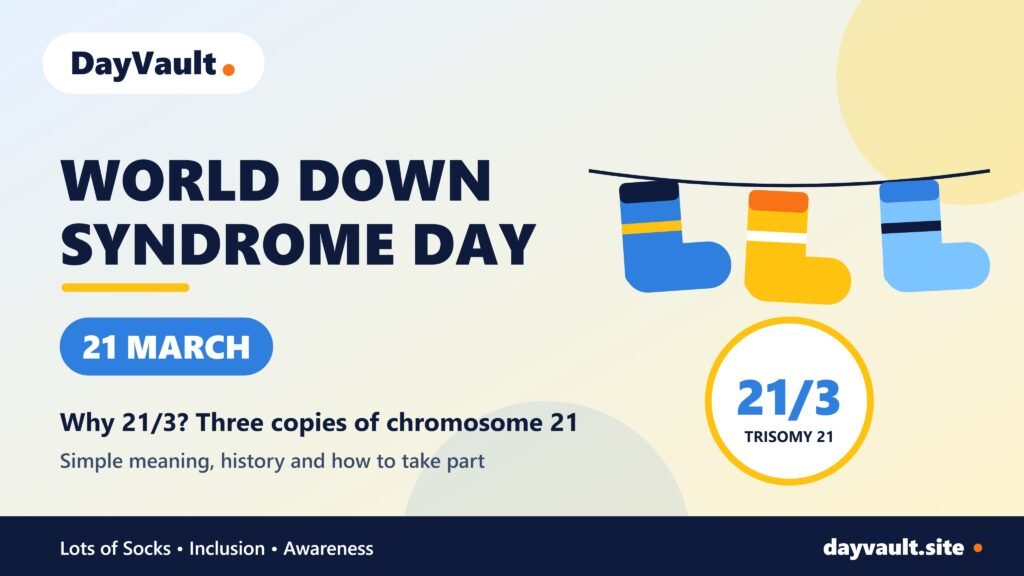
Why is World Down Syndrome Day on 21 March? Because the date can be written as 21/3, or 3/21: the 21st day of the 3rd month. Down syndrome is caused by three copies of chromosome 21 instead of two, so the date is a simple, memorable symbol of the condition itself.
That small piece of numerical wordplay has become one of the most recognisable dates in the awareness calendar. Every year, people around the world wear bright, mismatched socks, join school and workplace events, and speak up for the rights and inclusion of people with Down syndrome.
The short answer: what does 21 March mean?
The date works on two levels:
- The day: the 21st
- The month: the 3rd (March)
Together, 21/3 matches the three copies of chromosome 21 found in people with Down syndrome, which is also why the condition is often called trisomy 21. The organisers of the day describe the date in exactly these terms.
When is World Down Syndrome Day?
World Down Syndrome Day is observed every year on 21 March. It is a fixed calendar date, so it never moves. Only the weekday changes:
- 21 March 2026: Saturday
- 21 March 2027: Sunday
- 21 March 2028: Tuesday
Many schools and workplaces hold their activities on the nearest weekday when the date falls on a weekend. In 2026, for example, some schools held their sock events on Friday 20 March.
What is Down syndrome?
Down syndrome is a genetic condition that occurs when a person has an extra copy, whole or partial, of chromosome 21. People are born with it, and it is not an illness. The United Nations notes that it has always been part of the human condition.
There are three recognised forms:
- Trisomy 21, the most common form, where there is a full extra copy of chromosome 21
- Mosaic Down syndrome, where only some cells carry the extra copy
- Translocation Down syndrome, where extra chromosome 21 material is attached to another chromosome
People with Down syndrome have a wide range of abilities, personalities and interests, like everyone else. The day exists to celebrate that, and to push for equal access to education, healthcare, work and community life.
History and origin of World Down Syndrome Day
The day grew from the ground up before it became a United Nations observance.
From a symbolic date to a global day
According to the French Association for Research on Trisomy 21 (AFRT), the group chose 21 March (21/3 in French, 3/21 in English) as a symbolic date in 2005. The first events marking the date took place on 21 March 2006, including a meeting organised on behalf of the European Down Syndrome Association in Palma de Mallorca.
The campaign for UN recognition
In 2011, Down Syndrome International (DSi) campaigned for the date to be formally recognised. Its international petition gathered more than 12,000 signatures in two weeks and was presented to the chair of the UN General Assembly’s Third Committee. Down syndrome groups around the world also urged their governments to support the proposal.
The UN resolution
The draft resolution, led by Brazil with Poland, was adopted by consensus in the Third Committee on 10 November 2011. It was co sponsored by 78 UN Member States.
On 19 December 2011, the General Assembly adopted resolution A/RES/66/149. It decided to designate 21 March as World Down Syndrome Day, to be observed every year beginning in 2012. It also invited Member States, UN bodies, other organisations and civil society to raise public awareness of Down syndrome.
Is it an official international day?
Yes. World Down Syndrome Day is an officially designated United Nations observance, and has been observed by the UN since 2012. It is not a social media invention.
It helps to separate three layers:
- The date and designation: official, set by the UN General Assembly
- Annual themes and the global conference: organised by Down Syndrome International and partner organisations
- The Lots of Socks campaign: a popular awareness campaign, not a UN requirement
Why do people wear mismatched socks?
The Lots of Socks campaign is the most visible tradition of the day. Chromosomes are often said to look like socks when seen under a microscope, so colourful or odd socks became a playful symbol of the extra chromosome.
The idea also carries a gentle message: differences are worth celebrating. Brightly mismatched socks work as a conversation starter, and wearing them at school or work gives people a natural way to explain what the day is about.
Blue and yellow lights, ribbons and graphics are also commonly seen around the date.
Annual themes and the UN conference
Each year the day has a different theme. A global conference is held at United Nations Headquarters in New York around the date.
The 2026 theme was “Together Against Loneliness”, which focused on how loneliness affects people with Down syndrome and how communities can build real connections. Because the next theme is set by the organisers, check the official World Down Syndrome Day website for the 2027 theme.
Why the day matters
Awareness days only matter if they lead to something. For World Down Syndrome Day, the goals are practical:
- Promoting the full enjoyment of human rights by people with Down syndrome
- Improving public understanding and reducing stereotypes
- Encouraging inclusive schools, workplaces and communities
- Giving people with Down syndrome a visible voice in the conversation, rather than speaking for them
How to take part
You do not need to be an organisation to join in.
- Wear lots of socks. Bright, odd or several pairs at once all count.
- Learn first. Read material from Down Syndrome International or a national Down syndrome association before posting.
- Use respectful language. Put the person first (“a person with Down syndrome”). In the UK, “Down’s syndrome” is the common spelling.
- Share voices, not just facts. Amplify posts by people with Down syndrome and their families.
- Support inclusion locally. Back inclusive employers, sports clubs and community groups all year, not only on 21 March.
- Use the right hashtags. #WorldDownSyndromeDay and #LotsOfSocks are the widely used ones.
Related international days
Readers interested in this occasion often look for other disability and awareness observances. These are natural topics for DayVault to connect:
- World Autism Awareness Day (2 April), which the UN established in 2007
- International Day of Persons with Disabilities (3 December)
- Other UN designated health and rights days
FAQs
Why is World Down Syndrome Day on 21 March?
The date reads 21/3, matching the three copies of chromosome 21 (trisomy 21) found in people with Down syndrome.
When did World Down Syndrome Day start?
The date was first marked in 2006. The UN General Assembly officially designated it on 19 December 2011, with observance every year beginning in 2012.
Is World Down Syndrome Day recognised by the UN?
Yes. It was designated by UN General Assembly resolution A/RES/66/149.
Why do people wear odd socks on World Down Syndrome Day?
Chromosomes are said to look like socks under a microscope, so mismatched socks symbolise the extra chromosome and celebrate difference. The campaign is called Lots of Socks.
Does the date change every year?
No. It is always 21 March. Only the weekday changes.
What was the theme in 2026?
“Together Against Loneliness.”
What does trisomy 21 mean?
It means three copies of chromosome 21 instead of two. It is the most common form of Down syndrome.
Conclusion
The answer to why World Down Syndrome Day is on 21 March fits in one line: 21/3 stands for three copies of chromosome 21. Behind that simple idea is a global movement that began with small groups in 2006 and became a UN observance in 2011. This 21 March, a pair of odd socks is a good start, and lasting inclusion is the goal.
