Audience: worldwide. I checked the facts below against UN sources and the UN General Assembly record.
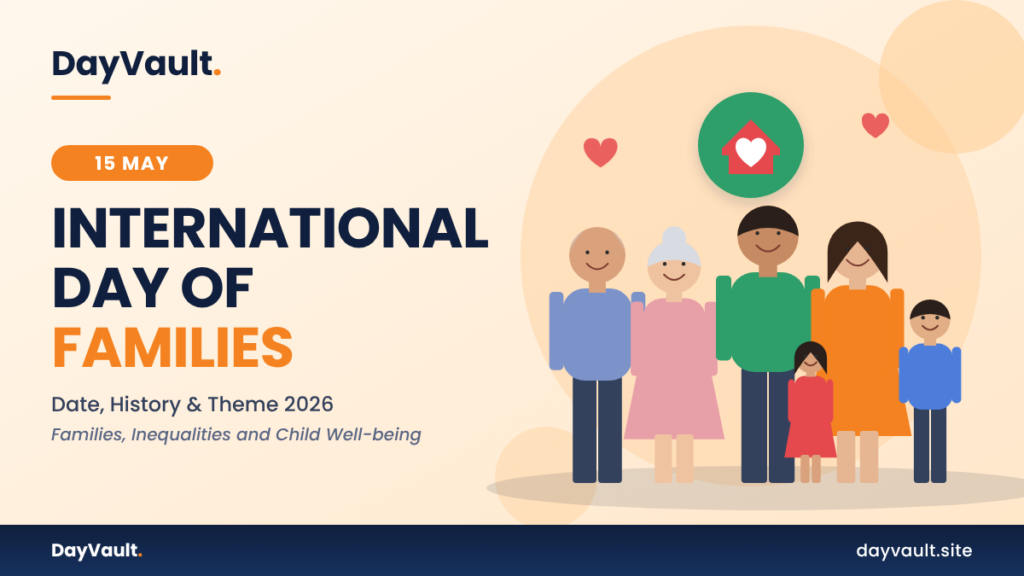
International Day of Families is observed every year on 15 May. It is a UN observance that reminds the world that strong families help build strong societies. It also draws attention to the social, economic and demographic pressures that families face today.
If you want to know when it falls, why it exists and how people mark it, this guide covers it.
When Is International Day of Families?
International Day of Families falls on 15 May every year. The date is fixed, so it does not move like some holidays.
- 2026: Friday, 15 May (already observed)
- 2027: Saturday, 15 May
It is a global awareness day, not a public holiday. Offices, schools and shops stay open in most countries, but many communities hold events around the date.
What Is International Day of Families?
International Day of Families is an official United Nations observance. Its purpose is to raise awareness of issues that affect families and to improve understanding of the social, economic and demographic changes that shape family life.
It is not a day about one type of family. The UN focus is on family well being in general, including household support, child welfare, education, health and fair access to opportunities.
The day also has an official symbol: a green circle with a red house and a heart in the centre. The house stands for shelter and stability, and the heart for care.
History and Origin
In the 1980s, the United Nations began paying closer attention to family issues. In 1989, the General Assembly proclaimed 1994 the International Year of the Family (resolution 44/82) to raise awareness and help countries develop better family focused policies.
Then, on 20 September 1993, the General Assembly adopted resolution 47/237. It decided that, beginning in 1994, 15 May of every year would be observed as the International Day of Families.
In short:
- 1989: The UN proclaims 1994 as the International Year of the Family.
- 1993: The General Assembly sets 15 May as the annual observance.
- 1994: The first International Day of Families is observed.
So the day grew out of the International Year of the Family, and it keeps that work going every year.
Why Is International Day of Families Celebrated?
Families are where most people first learn about care, language, values and belonging. When families are supported, children tend to do better, and communities become more stable.
The day exists to:
- Highlight the role of families in social development
- Encourage family friendly policies, such as childcare, healthcare and education support
- Raise awareness of problems like poverty, inequality and housing insecurity
- Promote research into how families are changing
- Remind people to value time with their own families
Theme for 2026: Families, Inequalities and Child Well being
Each year the UN chooses a theme. The 2026 theme is “Families, Inequalities and Child Well being.”
It focuses on how widening inequalities shape family life and children’s futures. The UN observance aims to:
- Improve understanding of how inequality harms families and children
- Promote investment in integrated, family oriented policies and services
- Highlight good practices and encourage new research on inequality trends
A main event was held at UN Headquarters in New York, with UN experts, academics and civil society representatives discussing practical policy solutions.
The theme for 2027 had not been announced when this article was written. Check the UN observances page closer to May 2027.
Examples of past themes
Themes change with global concerns. A few examples:
- 1996: Families: First Victims of Poverty and Homelessness
- 2005: HIV/AIDS and Family Well being
- 2021: Families and New Technologies
- 2024: Families and Climate Change
This shows how the day adapts to the issues of its time, from poverty and health to technology and the environment.
Why Families Matter: Key Ideas Behind the Day
Family life looks different around the world. Some households have two parents, some have one. Some include grandparents, and some are extended families living together. The UN recognises the family as a basic unit of society while accepting that family structures have changed.
Three ideas appear again and again in the observance:
Support helps families thrive. Access to healthcare, education, decent work and social protection gives families a stable base.
Children are affected first. When a household faces money problems or poor housing, children often feel it most. This is why the 2026 theme links families with child well being.
Policy and daily life connect. Parental leave, childcare and housing support are not only government topics. They shape what family life is like at home.
How Is International Day of Families Celebrated Around the World?
There is no single worldwide tradition. Observances are mostly local, and they vary by country, community and organisation. Common activities include:
- Conferences, workshops and panel discussions
- Radio, television and newspaper programmes about family issues
- Cultural programmes and community events
- School activities that encourage children to talk about family
- Awareness campaigns by charities and child welfare groups on social media
At the international level, the UN hosts an annual event, and organisations share messages online using hashtags such as #FamilyDay or #InternationalDayOfFamilies.
How to Celebrate International Day of Families
You do not need a big event. Simple ideas work well.
At home
- Cook a meal together and let everyone choose a dish
- Look through old photo albums and share stories
- Start a family tradition, like a monthly game night
- Write short thank-you notes to relatives
- Put phones away for a few hours and focus on each other
In your community
- Visit an older relative who lives alone
- Volunteer with a local charity that supports children or families in need
- Donate food, clothes or school supplies
- Invite a neighbour who may not have family nearby
At work or school
- Share the theme in a team meeting or classroom
- Organise a talk on work life balance or child well being
- Encourage flexible, family friendly practices where possible
Online
- Share a family memory or a message of support
- Learn about the yearly theme and share what you find
Interesting Facts About International Day of Families
- The day was created in 1993, but the first observance was in 1994.
- The UN green circle symbol with a house and heart is used on observance materials.
- Themes change each year, so the day follows global issues rather than staying fixed.
- The International Year of the Family in 1994 started the global conversation that led to this day.
- It is a UN observance, not a public holiday.
Related International and National Days
If you enjoy this occasion, these related days may interest you:
- International Day of Parents (1 June)
- International Day of Happiness (20 March)
- International Day of Friendship (30 July)
- International Day of Older Persons (1 October)
- World Children’s Day (20 November)
Mother’s Day and Father’s Day are national or cultural observances. Their dates vary by country, and they are separate from this UN day.
Frequently Asked Questions
When is International Day of Families?
It is observed on 15 May every year. In 2027 it falls on a Saturday.
Who started International Day of Families?
The United Nations General Assembly established it through resolution 47/237, adopted in 1993.
When was International Day of Families first celebrated?
It was first observed in 1994, the same year as the International Year of the Family.
What is the theme of International Day of Families 2026?
The theme is “Families, Inequalities and Child Well being.”
Is International Day of Families a public holiday?
No. It is an international awareness day and not a public holiday.
What is the symbol of International Day of Families?
A green circle with a red house and a heart in the centre. It stands for the safe, supportive home that families provide.
What is the difference between International Day of Families and Family Day?
International Day of Families is a UN observance on 15 May. “Family Day” is a name used for separate national or regional holidays in some countries, with different dates and traditions.
Conclusion
International Day of Families is a good moment to value the people closest to you and to think about how societies can support them better. The day can be as small as a shared meal or as big as a community project, and what matters is the attention you give to family well being.
you may also read this blog post
