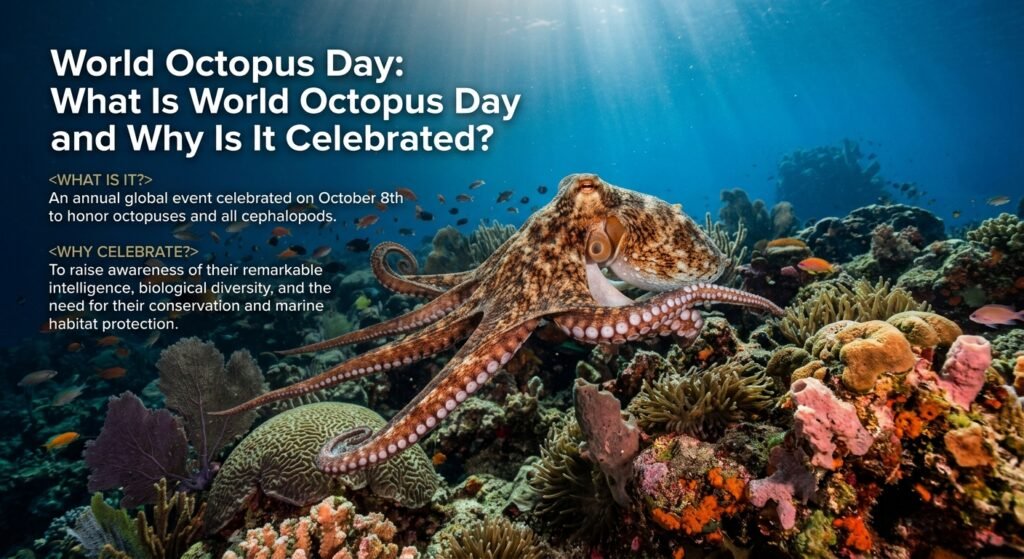
If you searched for “word octopus day,” you probably mean World Octopus Day, an annual observance dedicated to one of the ocean’s most unusual and intelligent animals. World Octopus Day is celebrated every year on October 8, giving people an opportunity to learn more about octopuses, their remarkable abilities, their role in marine ecosystems, and the importance of protecting ocean life.
Unlike major public holidays, World Octopus Day is primarily an awareness and educational observance. It is a chance to appreciate an animal that seems almost alien compared with humans. Octopuses have eight arms, three hearts, blue blood, sophisticated nervous systems, remarkable camouflage abilities, and impressive problem-solving skills.
But there is more to this day than sharing amusing octopus pictures or interesting facts. Learning about these animals can also encourage a better understanding of marine ecosystems and the challenges faced by ocean wildlife.
What Is World Octopus Day?
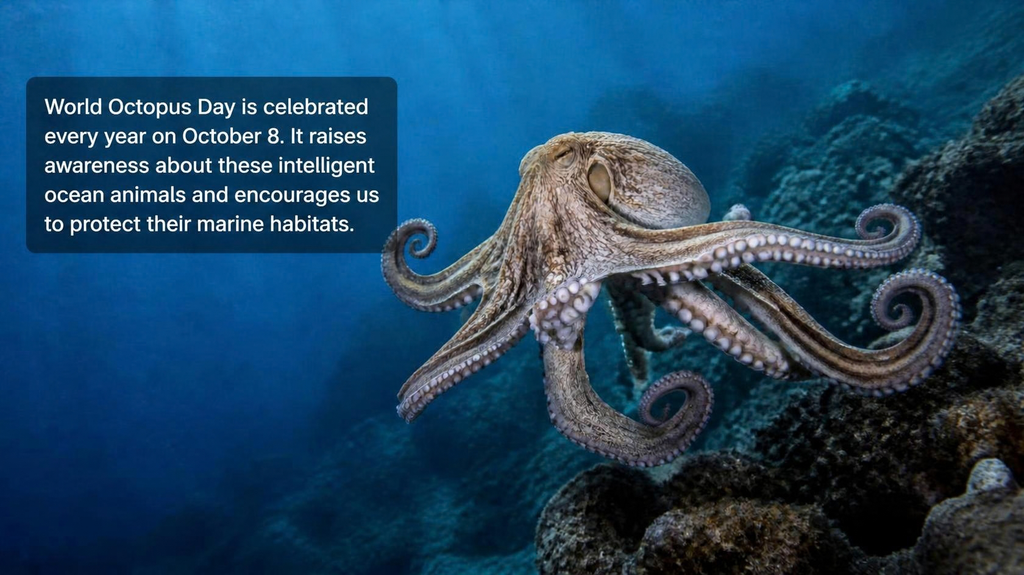
World Octopus Day, also called International Octopus Day, is observed on October 8 every year. The date is part of the wider International Cephalopod Awareness Days, which run from October 8 through October 12 and highlight different members and themes associated with cephalopods.
Octopus Day focuses specifically on octopuses and their unusual biology, intelligence, behavior, and place in the marine environment.
The observance is not simply about celebrating a strange-looking sea creature. It also encourages people to become more curious about marine life and consider how human activities can affect ocean animals.
For many people, October 8 is an easy reminder to stop for a moment and discover something new about the ocean.
When Is World Octopus Day?
World Octopus Day takes place on October 8 every year.
In 2026, World Octopus Day falls on Thursday, October 8. The date does not change from year to year.
The October 8 date is especially memorable because the octopus is famous for having eight arms. It also marks the beginning of the International Cephalopod Awareness Days, a series of observances dedicated to increasing public interest in cephalopods.
International Cephalopod Awareness Days
The wider observance includes several days:
- October 8 – Octopus Day
- October 9 – Nautilus Night
- October 10 – Squid and Cuttlefish Day
- October 11 – Kraken Day
- October 12 – Fossil Day
This sequence provides an opportunity to explore both living and extinct members of the broader cephalopod group.
Why Are Octopuses So Fascinating?
Few marine animals attract as much curiosity as the octopus.
Part of the fascination comes from appearance. An octopus has a soft body, eight flexible arms, large eyes, and no rigid skeleton. That unusual structure allows it to move through spaces that would be impossible for many other animals.
But its biology is even more impressive.
Octopuses Have Three Hearts
One of the best-known octopus facts is that an octopus has three hearts.
Two hearts pump blood toward the gills, where oxygen is absorbed. The third heart circulates oxygenated blood through the rest of the body. Octopus blood is also blue because it uses a copper-containing protein called hemocyanin to transport oxygen.
This is a completely different system from the human cardiovascular system and is one reason octopuses are so interesting to scientists.
Their Intelligence Is Remarkable
Octopuses are widely recognized for sophisticated behavior and problem-solving abilities.
Researchers have observed octopuses learning from their surroundings, solving problems, manipulating objects, and adapting their behavior. Their nervous systems are highly complex for invertebrate animals, making them important subjects in studies of animal intelligence.
Their intelligence is particularly fascinating because octopuses evolved very differently from mammals. Their abilities demonstrate that complex behavior and learning can develop along very different evolutionary paths.
Their Arms Are More Than Limbs
An octopus does not rely on its brain alone to control every movement of its arms.
A substantial portion of its nervous system is distributed throughout its body and arms, allowing the animal to coordinate movement and respond to its environment in sophisticated ways.
This distributed nervous system contributes to the unique way octopuses explore objects, manipulate their surroundings, and move through water.
How Do Octopuses Change Color?
Another reason World Octopus Day attracts attention is the octopus’s extraordinary ability to change its appearance.
Octopus skin contains specialized structures that allow changes in color and patterns. These abilities can help an octopus blend into its surroundings, communicate, or respond to different situations.
Camouflage is particularly important for an animal that has a soft body and no protective shell.
Instead of relying on armor, many octopuses depend on hiding, changing their appearance, moving quickly, or disappearing into crevices when threatened.
The Smithsonian notes that specialized skin cells called chromatophores play an important role in the octopus’s ability to change color.
This ability is one of the clearest examples of how evolution has produced remarkably specialized adaptations in marine animals.
Are Octopuses Intelligent Animals?
Yes. Scientific research provides substantial evidence that octopuses possess sophisticated cognitive and behavioral abilities.
Their intelligence can be seen in several areas:
- Learning from experience
- Solving problems
- Exploring unfamiliar objects
- Manipulating objects
- Adapting behavior to different situations
- Remembering information
- Using their flexible bodies in highly coordinated ways
Modern research has also expanded the discussion beyond intelligence to the question of sentience, meaning the capacity to experience feelings.
A 2026 review published in Biological Reviews evaluated evidence concerning sentience across cephalopods. The researchers found strong evidence supporting sentience in octopuses and highlighted important implications for animal welfare and ethical treatment.
This research is significant because it encourages people to think about octopuses as complex animals rather than simply unusual seafood or aquarium attractions.
Why Does World Octopus Day Matter?
At first glance, an octopus awareness day might seem like a fun entry on an October calendar. However, awareness days can have a broader purpose.
World Octopus Day encourages people to:
- Learn about marine animals
- Understand ocean ecosystems
- Appreciate biodiversity
- Explore the science of animal intelligence
- Think about marine conservation
- Consider responsible treatment of wildlife
Octopuses are part of complex marine food webs. Like other marine species, they are affected by environmental changes, fishing activity, pollution, habitat disturbance, and other human pressures.
World Animal Protection specifically highlights concerns surrounding marine pollution and the development of octopus farming, making the day an opportunity to discuss animal welfare as well as appreciation.
How Can You Celebrate World Octopus Day?
You do not need to organize a large event to take part in World Octopus Day.
A simple activity can turn October 8 into an opportunity to learn something new.
1. Learn Five New Octopus Facts
Spend a few minutes reading about octopus biology. You might explore their nervous system, camouflage, feeding behavior, habitats, or different species.
Learning even a handful of facts can completely change the way you view these animals.
2. Visit an Aquarium
If you have access to a reputable aquarium with an octopus exhibit, visiting can be an excellent educational activity.
Instead of simply looking at the animal, observe its behavior. Watch how it moves, explores its environment, changes position, and interacts with objects.
Always follow aquarium rules and avoid disturbing the animals.
3. Watch a Marine-Life Documentary
A good documentary can provide a closer look at underwater ecosystems and the animals that live within them.
Choose educational material from a reputable scientific, conservation, aquarium, or nature organization whenever possible.
4. Read About Cephalopods
World Octopus Day is also a good starting point for learning about the wider cephalopod family.
Depending on your interests, you can explore:
- Squid
- Cuttlefish
- Nautiluses
- Fossil cephalopods
- Marine evolution
- Underwater ecosystems
The International Cephalopod Awareness Days provide a natural framework for exploring these topics throughout October 8–12.
5. Share Educational Information
If you use social media, consider sharing an interesting fact about octopuses rather than simply posting a generic holiday message.
For example, you could explain why octopus blood is blue, how camouflage works, or why researchers are interested in octopus intelligence.
Educational posts can help introduce other people to marine science.
6. Support Ocean Conservation
One of the most meaningful ways to recognize an animal awareness day is to think about conservation.
You can support ocean health through everyday choices such as reducing unnecessary plastic use, disposing of waste responsibly, learning about sustainable seafood, and supporting credible marine conservation organizations.
Small actions do not solve every environmental problem, but they can contribute to greater awareness and responsible behavior.
Interesting Octopus Facts to Share
Looking for quick facts for a classroom, social media post, or conversation?
Here are several reliable facts worth remembering:
- Octopuses have three hearts.
- Their blood is blue because of the oxygen-carrying protein hemocyanin.
- They have eight arms, rather than four arms and four tentacles.
- They can use sophisticated camouflage to blend into their surroundings.
- Octopuses are among the most behaviorally complex invertebrates.
- They are members of the cephalopod group.
- Their nervous systems are unusually complex for invertebrates.
- Scientific research increasingly supports serious consideration of octopus welfare and sentience.
These facts show why an animal that may look strange at first can become one of the most fascinating creatures to study.
What Is the Difference Between an Octopus and a Squid?
Octopuses and squids are both cephalopods, but they have important differences.
An octopus generally has a rounded body and eight arms. Squids typically have a more streamlined body and possess eight arms plus two longer tentacles.
Octopuses are usually associated with crawling along the seafloor and hiding in rocky environments, while many squid species are adapted for faster open-water movement.
Both animals have sophisticated nervous systems, excellent sensory abilities, and remarkable adaptations to life in the ocean.
World Octopus Day focuses specifically on octopuses, while the wider International Cephalopod Awareness Days recognize a much broader range of cephalopod life.
Why Octopus Conservation Deserves Attention
The more scientists learn about octopuses, the more complicated the conversation around their protection becomes.
Octopuses are not simply visually interesting animals. Research increasingly points toward sophisticated behavior and meaningful welfare considerations.
A 2026 scientific review found strong evidence supporting sentience in octopuses and argued that welfare concerns deserve greater attention in research and commercial practices.
This does not mean every conservation question has a simple answer. Marine ecosystems are complicated, and different regions face different pressures.
However, better scientific knowledge can help society make more informed decisions about how marine animals are studied, captured, transported, kept, and managed.
That is an important message to take away from World Octopus Day.
Frequently Asked Questions
When is World Octopus Day?
World Octopus Day is celebrated annually on October 8. In 2026, it falls on Thursday, October 8.
Is World Octopus Day the same as International Octopus Day?
Yes. The names World Octopus Day and International Octopus Day are commonly used for the October 8 observance. It is also sometimes called Octopus Day or Octopus Appreciation Day.
Why is October 8 World Octopus Day?
October 8 is used for Octopus Day as part of the International Cephalopod Awareness Days. The date also fits naturally with the octopus’s most recognizable feature: its eight arms.
How many hearts does an octopus have?
An octopus has three hearts. Two pump blood through the gills, while the third circulates oxygenated blood through the body.
What is the best way to celebrate World Octopus Day?
A good way to celebrate is to learn about octopus biology, visit a responsible aquarium, watch an educational marine documentary, explore cephalopod science, or support credible ocean-conservation efforts.
Conclusion
World Octopus Day is more than an unusual date on the October calendar. It is an opportunity to discover one of the ocean’s most remarkable animals and understand why octopuses have fascinated scientists and the public for generations.
If you came here searching for “word octopus day,” the observance you were likely looking for is World Octopus Day, celebrated every October 8.
From three hearts and blue blood to extraordinary camouflage and complex behavior, octopuses challenge many assumptions about what an intelligent animal can look like. Modern research is also encouraging a deeper discussion about their sentience and welfare.
The simplest way to mark the day is to stay curious. Learn something new, share an accurate fact, explore the world of cephalopods, and think about how healthier oceans benefit the remarkable animals that live in them.
Sometimes, understanding an unusual creature is the first step toward caring more about the world it calls home.
Frequently Asked Questions
1. When is World Octopus Day?
World Octopus Day is celebrated every year on October 8.
2. Why is October 8 called World Octopus Day?
October 8 is observed as World Octopus Day as part of the International Cephalopod Awareness Days, celebrating octopuses and increasing awareness about these fascinating marine animals.
3. How many hearts does an octopus have?
An octopus has three hearts. Two pump blood to the gills, while the third pumps oxygenated blood throughout the body.
4. Why is octopus blood blue?
Octopus blood appears blue because it uses hemocyanin, a copper-based protein, to transport oxygen instead of the iron-based hemoglobin found in humans.
5. How can I celebrate World Octopus Day?
You can celebrate by learning octopus facts, visiting a responsible aquarium, watching a marine-life documentary, reading about cephalopods, or supporting ocean conservation efforts.
